
Home / Privacy / Signal audits
Has Signal been independently audited? What the reviews actually mean
Published: October 7, 2026 Updated: October 8, 2026
Yes. Signal has commissioned independent security audits of its protocol and apps over the years. Independent cryptographers and security firms have been paid to read Signal's code, try to break it, and publish what they found. That matters more than most marketing claims in the messaging world, but an audit is not a lifetime certificate of safety. This guide explains what a security audit actually is, what Signal's audits covered, what the published results did and did not find, and the honest limits of every audit ever done, without naming names or inventing findings.
from Signal's official site file hosted by Signal, not by us
What an independent security audit actually is
The word "audit" gets thrown around in tech marketing until it means nothing. A real security audit is a specific thing: a team of outside security experts is given full access to the source code, sometimes for weeks or months, and paid to find vulnerabilities. They read the cryptography implementation line by line, model the threats, try the attacks, and write up everything they found, from critical flaws to minor hardening suggestions.
Three things separate a real audit from marketing fluff:
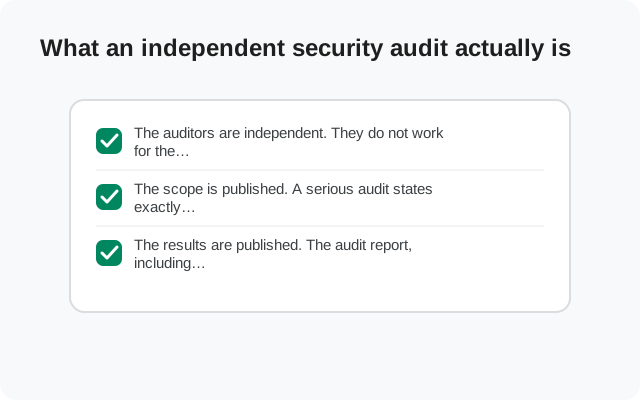
- The auditors are independent. They do not work for the company whose code they review. Their business depends on their reputation for honest findings, not on making clients look good.
- The scope is published. A serious audit states exactly what was reviewed: which code, which protocol version, which dates. "We audited everything" with no scope document is a red flag, not a comfort.
- The results are published. The audit report, including the findings and the company's response to each one, is made public. An audit nobody can read is just a rumor.
When you hear "Signal has been audited," this is the kind of exercise people are referring to. Not a marketing checklist, not a self-review, but outside experts paid to break things and report honestly.
What Signal's audits covered
Signal has commissioned independent audits at more than one point in its history, and they have looked at different layers of the system. Described generically, because the specifics live on Signal's own published pages and change as new audits happen:
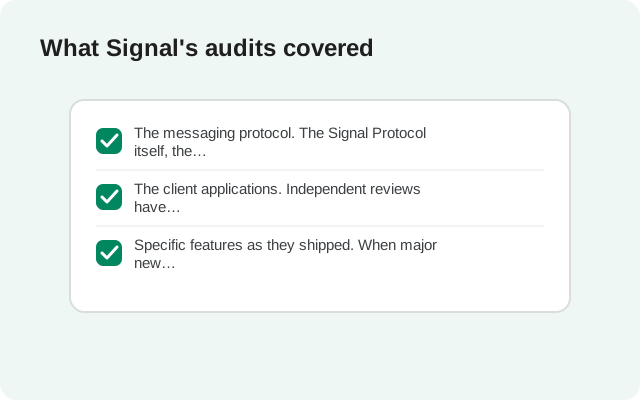
- The messaging protocol. The Signal Protocol itself, the cryptographic machinery that scrambles and unscrambles messages, has been reviewed by independent cryptographers. This is the layer every Signal message depends on, and it is also the layer that other apps (including WhatsApp's encryption) borrowed, which means it has attracted an unusual amount of outside academic attention on top of the commissioned audits.
- The client applications. Independent reviews have examined the apps that run on phones, the code that handles keys, message storage, and the parts of the app that touch the network.
- Specific features as they shipped. When major new cryptographic features arrived, they were put in front of reviewers rather than released on trust alone.
We are deliberately not naming firms, dates, or findings here. Audit specifics age: a review from years ago describes code that has since been rewritten, and listing findings out of context does more to mislead than to inform. If you want the specifics, the right source is Signal's own published material, which they link from their security pages. Treat anything else, including this page, as a map to the primary source, not the source itself.
What an audit proves (and does not prove)
An audit is strong evidence about one thing: at the time of the review, within the published scope, competent outsiders looked for flaws and found nothing above a stated severity, or found issues that were then fixed. That is genuinely valuable. It rules out whole categories of mistakes, sloppy cryptography, and back doors hiding in the reviewed code.
It does not prove:
- That the code is bug-free forever. The audit reviewed a snapshot. Every release since then contains code the auditors never saw. Software rots; new features introduce new risks.
- That the app on your phone matches the audited code. Auditors review source code. Your phone runs a compiled build. Closing that gap is the job of reproducible builds, which let outsiders verify that the published code produces the published app.
- That the servers behave. A client-side audit says nothing about what the server does with your traffic, which is a separate question with its own honest limits.
- That your endpoint is safe. No audit protects a phone full of malware, a shoulder-surfer, or a seized device. The cryptography can be flawless and your messages still readable off an unlocked screen.
The honest summary: audits are one of the strongest signals of good-faith engineering in this industry, and Signal has more of them than almost any competitor. They are evidence, not proof. Any app whose pitch is "we were audited once, so trust us forever" is misusing its own audit.
Frequently asked questions
Has Signal ever been audited by an independent firm?
Yes. Signal has commissioned independent security audits of its protocol and apps more than once, and independent cryptographers have also reviewed the Signal Protocol in academic work. The specifics are published on Signal's own security pages.
Did the audits find any backdoors in Signal?
No audit has ever reported a backdoor in Signal. Real audit reports did contain findings, as is normal, and they were addressed. A report with literally zero findings would be the suspicious one.
Does an audit mean Signal is 100 percent secure?
No. An audit is a point-in-time review of a published scope. It does not cover code written since, cannot confirm what the servers currently run, and says nothing about the security of your own phone.
Can I read Signals audit reports myself?
Yes, the reports and Signal's responses are published. Start from Signal's own security pages rather than third-party summaries, and read the scope document first.
Is Signal audited regularly or just once?
Audits have happened at multiple points in Signal's history, covering different layers such as the protocol and the client apps. Open-source code also gets continuous informal review by researchers and academics.
Why does Signals audit history matter more than competitors claims?
Because of the combination: commissioned audits plus published reports plus open-source code plus reproducible builds. Most messaging apps offer, at best, one of those. Ask any app for its audit report, scope, and date. Most marketing claims fail that test.
Audit vs bug bounty vs code review vs your own reading
People lump every kind of security review together. They are different tools with different strengths:
| Method | Who does it | Strength | Limit |
|---|---|---|---|
| Independent audit | Paid outside firm, full code access | Deep, systematic, scoped and published | Snapshot in time; scope can miss things |
| Bug bounty | Anyone in the world, ongoing | Continuous; catches what audits missed | Uneven coverage; researchers chase payouts |
| Internal review | The company's own engineers | Knows the codebase best | Blind to its own assumptions; not independent |
| Public code reading | Volunteers, academics, rivals | Free, endless, adversarial | Nobody is assigned; unglamorous code goes unread |
Signal benefits from all four: commissioned audits, a standing invitation for researchers to poke at it, its own cryptographers, and open-source code that academics and competitors read for professional reasons. No single row in that table is enough on its own. Together they are a strong posture.
How to read an audit report like a professional
If you ever open a real audit report, here is how to read it without a security background:
- Start with the scope, not the findings. The scope tells you what was actually reviewed and, equally important, what was excluded. A clean report on a narrow scope is less reassuring than it looks.
- Expect findings. A report with zero findings is suspicious. Real audits always find something: hardening suggestions, minor issues, theoretical concerns. A handful of low-severity findings that were fixed is the healthy, normal outcome. "No findings at all" usually means a shallow review.
- Read the company's response. Serious audits publish how each finding was addressed: fixed, mitigated, or accepted with reasoning. The response matters as much as the findings.
- Check the date and version. Match the audited version against what you run today. An audit of a 2021 codebase tells you about 2021, not about the app on your phone now.
This is also how to evaluate competing apps' audit claims. Ask for the report, read the scope, check the date. Most "audited" marketing in the messaging space wilts under those three questions.
Why audits and open source reinforce each other
An audit of closed-source software asks you to trust the auditors. An audit of open-source software lets you verify. Signal's code is public, which means the audit reports can be checked against the actual code, the fixes can be confirmed by anyone, and researchers can keep looking long after the auditors' contract ended. Our open-source explainer covers exactly what is public and the one honest caveat about the server side.
The combination is what matters: open code plus commissioned audits plus reproducible builds is a verification chain, where each link covers the others' weaknesses. Open code without audits means nobody was assigned to look. Audits without open code means you cannot check the auditors' work. Builds without reproducibility means the audited code might not be the code on your phone. Signal has all three for its clients, which is rare.
What no audit can cover
Two gaps deserve honest mention, because they are where overconfident audit-talk goes wrong:
- The server deployment. Audits review code, and Signal publishes its server code too. But nobody outside Signal can verify that the servers currently running are built from that published code. This is the standard caveat of the whole industry, and Signal is not worse than average here, but "the server code was audited" is not the same as "the server runs the audited code." More in our server code guide.
- Your phone. Every audit in the world assumes a reasonably secure endpoint. Spyware on your device, a coerced unlock, or a seized phone bypasses cryptography entirely. If your threat model includes any of those, audits are not your line of defense. Our honest privacy review walks through what Signal can and cannot protect against.
None of this diminishes what audits do. It just puts them in their place: the strongest available evidence about the code, at a point in time, within a published scope. Used that way, Signal's audit history is genuinely reassuring. Used as a magic word, it is marketing.
Keep reading
- is Signal open source?: what code is public and the server caveat
- Signal's server code: what's actually open: the honest limit on server transparency
- is Signal really private? an honest review: what audits can't cover
- how Signal's encryption works: the protocol the auditors reviewed
from Signal's official site file hosted by Signal, not by us