
Your messages are already sealed. So what is a VPN for?
Published: October 7, 2026
Short answer: for protecting your message content, you do not need a VPN with Signal. End-to-end encryption already seals your messages so thoroughly that no VPN could add anything to it. A VPN does something different: it hides which services you use from your internet provider, and hides your real IP address from Signal's servers. That matters in exactly two situations: when Signal is censored or blocked where you are, and when the mere fact that you use Signal must stay hidden from whoever watches your network. For everyone else, a VPN on top of Signal is redundant for privacy, and this guide explains why, honestly, without selling you anything.
The confusion is understandable. VPN marketing claims "total privacy," and Signal promises "private messaging," so people assume they stack. They do not stack the way you think. They protect different things, and Signal already covers the part most people actually care about. Let us separate the layers.
What Signal's encryption already covers
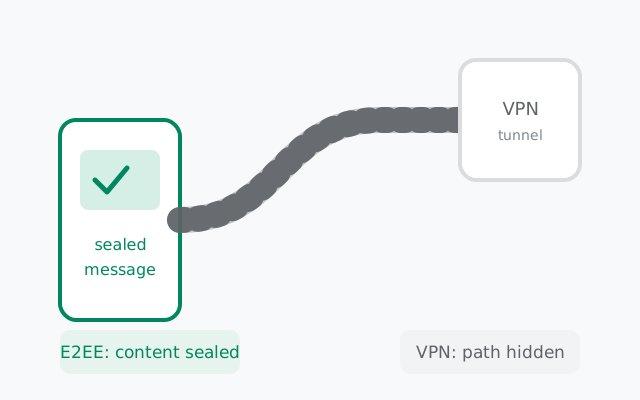
Every message, call, photo, voice note, and story you send in Signal is sealed with end-to-end encryption before it leaves your phone. "End-to-end" means the content can only be opened by the sender's and recipient's devices. Not by Signal, not by your internet provider, not by the VPN company, not by anyone in the middle. This is true whether or not you run a VPN. A VPN encrypts the path between you and the VPN server; Signal encrypts the content itself. The content encryption is the stronger protection, and it is already on.
Concretely, here is what nobody can see about your Signal activity because of encryption, VPN or no VPN:
- Message contents. Nobody in the middle can read what you wrote, what photos you sent, or what you said on a call.
- Who the message is for. Sealed sender hides the sender's identity from Signal's own servers where both sides support it (see our sealed sender explainer).
- Anything inside the encrypted tunnel. Your provider sees encrypted traffic to Signal's servers; the shape and timing of it, but never the substance.
This is why "do I need a VPN for Signal to be private" has such a clean answer: the privacy of your conversations does not depend on a VPN at all. If your worry is "can my ISP read my chats", it cannot, with or without a VPN. If your worry is "can the VPN company read my chats", it cannot either. The encryption makes both questions moot.
What a VPN actually adds, precisely
A VPN changes what your internet provider (and anyone watching your local network: the café Wi-Fi owner, the office network admin) can observe. Without a VPN, your provider sees: this customer connected to Signal's servers at these times, transferring roughly this much data. With a VPN, your provider sees: this customer connected to a VPN server at these times. The Signal part disappears from their view.
So the VPN's contribution is exactly two things:
- It hides the fact that you use Signal from your network observer. Your ISP, your employer, the hotel Wi-Fi: they see VPN traffic, not Signal traffic. If you live somewhere that Signal usage itself is sensitive, this is the whole ballgame.
- It hides your real IP address from Signal's servers. Signal sees the VPN server's IP instead of yours. This is a small addition. Signal stores very little about you anyway (see our metadata breakdown), but it is real.
Notice the symmetry of the trade: you hide Signal usage from your ISP by revealing it to the VPN provider instead. The VPN company now sees that you connect to Signal's servers. You have not eliminated the observation. You have moved it from one party to another. Whether that is an upgrade depends entirely on which party you trust less. More on choosing below.
from Signal's official site — file hosted by Signal, not by us
What a VPN does NOT do for you
The honest half of this page. A VPN does not:
- Make your messages "more encrypted." There is no double-sealing. The content encryption is already complete; the VPN adds a second tunnel around already-sealed content. Your chats are not 2x private.
- Hide you from the people you talk to. Your contacts still see your profile, your messages, your number or username. Everything the app shows them. A VPN changes nothing about the social layer.
- Protect a compromised phone. Spyware on your device sees your screen before anything is encrypted. No network tool fixes an endpoint problem.
- Stop screenshots, forwarding, or quotes. The recipient's behavior is outside every network protection.
- Hide your IP from call participants by itself. For that, Signal has its own relay calls option, which routes calls through Signal's servers so the other party never sees your IP. That is a Signal setting, not a VPN feature. It is the right tool for the job.
The pattern: VPNs protect the network path. Everything people actually worry about with messaging (who reads my chats, who sees my number, who screenshots my photos) lives above or below that path, where the VPN cannot reach.
When a VPN genuinely matters
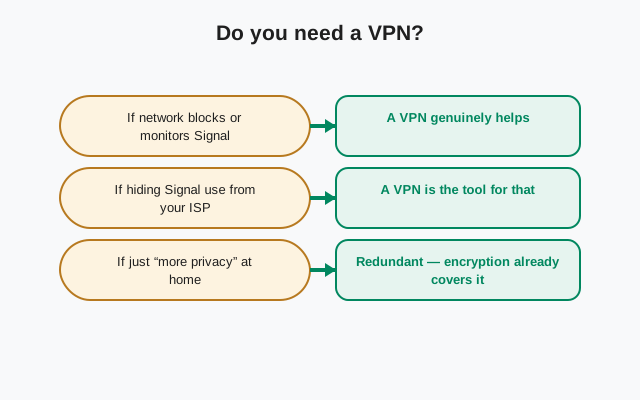
Two situations where a VPN on top of Signal is genuinely useful:
1. Signal is blocked or throttled where you are. Some countries and some networks block Signal outright. A VPN can carry your traffic past the block, since the censor sees only VPN traffic. Note that Signal also ships its own answer to this: built-in censorship circumvention and proxy support, which are purpose-built for the job and do not require trusting a VPN company. A VPN is one option among several here, not the only one.
2. The fact of using Signal must stay hidden from your network observer. Journalists, activists, or anyone whose threat model includes "my ISP / employer / government must not know I use an encrypted messenger." A VPN replaces "connects to Signal" with "connects to a VPN" in the observer's logs. That is exactly what is needed here. This is the one case where the VPN is not redundant but load-bearing.
Outside these two, you are buying a feeling. Which is fine. Feelings have value, but buy it knowingly.
When it is redundant
For ordinary use in an uncensored country, a VPN adds essentially nothing to Signal privacy:
- Your ISP cannot read your chats either way. Encryption already guarantees this. The VPN only changes whether the ISP knows you use Signal. In most countries, using Signal is unremarkable.
- Your IP is already hidden from contacts during calls if you enable relay calls. A free, built-in, one-toggle setting does the job better than a VPN (it hides your IP from the other person, which is usually the actual concern).
- Signal's servers learn very little about you regardless. Hiding your IP from a service that stores almost nothing is a small win on top of a small exposure.
- Link-preview fetches still come from your device. A VPN changes which IP the destination site sees, but the preview fetch still happens. The link preview guide explains why the toggle matters more than the tunnel.
The redundancy test is simple: ask what the VPN would change about your situation. If the answer is "my ISP would see VPN traffic instead of Signal traffic, and nobody cares either way", that is redundancy, and you can skip it.
Signal vs VPN vs Tor vs proxy: what each one protects
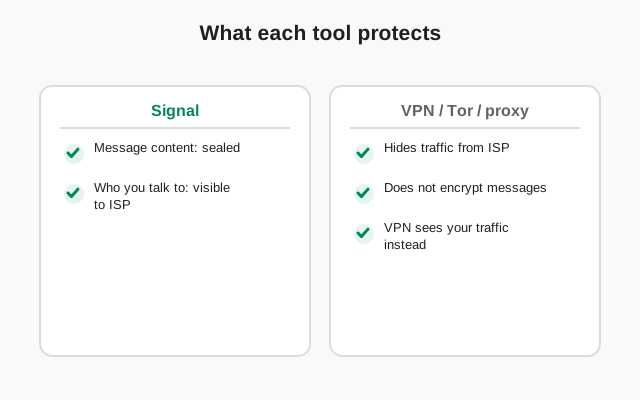
Four tools, four different jobs. People constantly substitute one for another; this table stops that.
| Tool | What it protects | What it does NOT protect | When to use it with Signal |
|---|---|---|---|
| Signal's end-to-end encryption | Message/call content from everyone except sender and recipient | The fact you use Signal; your IP from your provider; the recipient's behavior | Always. It is automatic |
| VPN (generic category) | Hides which services you use from your ISP/local network; hides your IP from Signal's servers | Message content (already sealed); anything the recipient does; a compromised phone | Censorship, or when Signal usage itself must stay hidden |
| Tor (generic category) | Strong anonymity of who is connecting, layered through multiple relays | Slow; not designed for real-time messaging; recipient-side risks unchanged | High-risk anonymity needs. Specialist territory, not everyday messaging |
| Signal's built-in proxy | Routes Signal traffic through a volunteer server to bypass blocks | Does not hide usage from a sophisticated observer the way a VPN does | When Signal is blocked and you want the purpose-built tool |
The takeaway: these are not competitors. Encryption is the foundation (automatic), relay calls handle the call-IP problem (one toggle), proxies and circumvention handle blocking (built in), and a VPN handles the "hide my usage from my network" problem (only when that problem exists). Use the tool that matches your actual problem.
If you decide you need one: choosing without the hype
No brand endorsements on this page. The VPN market's advertising is exactly the hype this guide is cutting through. Instead, the categories of things to check if you decide a VPN is warranted:
- Trust is the product. A VPN moves your traffic observation from your ISP to the VPN company. You are choosing who watches, not whether someone watches. Pick a provider you have real reasons to trust. Ideally one with independent audits of its no-logging claims, not just marketing copy. A free VPN that sells your data is strictly worse than no VPN.
- Jurisdiction matters. Where the company is based determines which governments can compel it. This matters exactly in the high-risk scenarios where a VPN is warranted. Which is to say, think about it precisely when the stakes are real.
- Do not expect it to fix Signal-specific issues. A VPN will not hide your number, stop screenshots, or make disappearing messages work better. Pair it with the actual lockdown checklist instead of treating it as a substitute.
- Test that Signal still works well. Some VPN servers are slow or get flagged; if calls drop or messages lag, the VPN is hurting the thing it was meant to protect. A privacy tool that breaks your messaging gets turned off. Then it protects nothing.
And the final honest word: most readers of this page do not need a VPN for Signal. If you are in an uncensored country with ordinary privacy concerns, your fifteen minutes are far better spent on the lockdown checklist than on VPN shopping. The encryption is doing the heavy lifting already. Let it.
Frequently asked questions
Do I need a VPN to use Signal privately?
No. Signal's end-to-end encryption already seals your message content from your ISP, the VPN company, and everyone in the middle. A VPN only hides the fact that you use Signal from your network observer. Useful under censorship, redundant otherwise.
Does a VPN make Signal messages more encrypted?
No. There is no double-sealing. Your messages are already fully encrypted, and a VPN just adds a tunnel around already-sealed content. It cannot make the encryption stronger.
Can my ISP see that I use Signal if I use a VPN?
No. With a VPN active, your ISP sees only VPN traffic, not Signal traffic. Without a VPN, your ISP can see that you connect to Signal's servers (but never your message contents).
Does a VPN hide my IP address during Signal calls?
From your ISP and from Signal's servers, partially. But the other call participant is the usual concern, and for that Signal's own relay-calls setting is the right tool: it routes calls through Signal's servers so neither side sees the other's IP.
Is Tor better than a VPN for Signal?
They solve different problems. Tor provides stronger anonymity about who is connecting but is slow and not designed for real-time messaging. For everyday Signal use under no censorship, neither is needed; for high-risk anonymity, get specialist guidance rather than improvising.
Keep reading
- Censorship circumvention built-in: Signal's own answer to blocked networks
- Set up a Signal proxy: the purpose-built tool for blocked regions
- Call privacy — hide your IP: relay calls, the one-toggle fix
- Privacy guides hub: every Signal privacy guide in one place