
Is Signal safe for activists? The honest answer
Published: October 7, 2026 · Updated: October 8, 2026
Yes, Signal is the safest mainstream messenger for activists, and it is the standard recommendation for a reason: genuine end-to-end encryption, minimal metadata, and a track record of surviving government data demands. But "safest" is not "magic." No app protects you from a seized unlocked phone, a compromised contact, or a network that watches who talks to whom. The honest answer has two halves: what Signal does genuinely well, and where the real risks live. This page gives you both, plus the operational practices that turn a good app into a workable security posture, and the myths you should stop believing.
The short answer
For the vast majority of activist threat models, Signal is the right answer and the rest of this page is about using it well rather than replacing it. If your adversaries are platform surveillance, dragnet data collection, corporate data harvesting, or a government requesting records from a company, Signal's design answers each of them. There is no message content to subpoena, minimal metadata to hand over, and no advertising business model quietly profiling you.
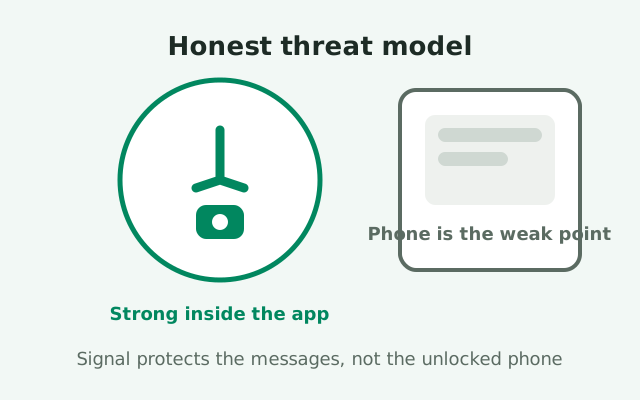
The honest part: Signal protects messages in transit and at rest on Signal's servers. It does not protect the phone in your hand, the people you talk to, or the network patterns your traffic creates. Most real-world compromises of activists happen at those three points, not inside the encryption. So the correct mental model is that Signal solves the cryptography problem completely and leaves the operational problems to you. An activist who understands that division is far safer than one who believes any single app makes them untouchable.
One more framing note before the details. "Activist" covers everything from a neighborhood organizer to a journalist's source to someone coordinating protests under an authoritarian government, and the right precautions differ enormously across that range. What follows is honest general guidance, not a bespoke security plan. If the stakes include arrest or physical harm, talk to a digital-security trainer from a reputable press-freedom or human-rights organization. This page cannot substitute for that, and it will not pretend to.
Why Signal is the standard recommendation
Encryption on for everything by default
Signal earned its reputation through design choices, not marketing. First, end-to-end encryption is on for everything by default: every message, call, and video call, with no "secret chat" mode you have to remember to enable. There is no configuration step an adversary can hope you skipped. The encryption protocol is open and has been audited repeatedly, and the client code is open source, which means the security claims are checkable rather than promised.
It collects remarkably little
Second, Signal collects remarkably little. The server does not see message contents, contact lists, group membership details, or profile information in readable form. When governments have served Signal with data demands, the published responses show how thin the record is: essentially the account creation date and the last connection time. Compare that with platforms that store years of chat history, full contact graphs, and location data, and the difference in exposure is enormous. You cannot leak what was never stored.
Built-in features, not bolted-on
Third, the features activists actually need are built in rather than bolted on. Disappearing messages shrink the window of exposure if a device is later seized. Sealed sender reduces the metadata about who is messaging whom. Registration lock means a stolen SIM alone cannot take over the account. Screen lock and screen security protect against casual access and screenshots. These are not obscure settings; they are one or two taps away in the app, and the privacy checklist walks through all of them.
Structured to resist pressure
Fourth, the organization behind it is structured to resist pressure. Signal is run by a nonprofit foundation, not a company with advertisers or shareholders, and its funding model does not depend on harvesting user data. That does not make it invincible, but it removes the most common reason messaging companies quietly cooperate with surveillance: the business model. When evaluating any tool for sensitive work, follow the incentives, and Signal's incentives point the right way.
What Signal cannot protect you from
Endpoint seizure defeats every messenger
Now the other half, stated plainly. Endpoint seizure defeats every messenger. If authorities take your phone while it is unlocked, or compel you to unlock it, no encryption in the world helps; they read the messages on the screen like anyone else. Disappearing messages and a short screen-lock timeout reduce the exposure window, but they are mitigation, not immunity. This is the single most common real-world failure mode, and no app setting fixes it. The fix is operational: decide in advance what lives on the device and for how long.
Compelled unlock
Compelled unlock is the legal twin of seizure. In many jurisdictions, police can legally require you to provide a fingerprint or face to unlock a phone, and in some they can compel a passcode. Biometric unlock is convenient and legally weaker than a memorized passcode in several countries. If this threat is real for you, disable biometric unlock for Signal and the phone itself, and know the law where you operate. An app cannot out-lawyer a court order.
A compromised contact
A compromised contact compromises the conversation. Encryption protects messages between endpoints; it says nothing about whether the person at the other endpoint is trustworthy, careful, or free. One careless contact who screenshots chats, backs up to an insecure cloud, or talks under pressure exposes the whole group. Vet your contacts, keep sensitive groups small, and remember that safety number verification confirms you are talking to the right device, not that the person behind it can be trusted.
Network observation sees patterns, not content
Network observation sees patterns, not content. Your ISP or a state-level adversary cannot read your Signal messages, but they can see that you use Signal, when you connect, and roughly how much data moves. In some contexts that metadata alone is incriminating. Mitigations exist, from VPNs to Signal's built-in proxy support designed for censored regions, but they add complexity and their own risks. Know that the traffic pattern is visible even when the content is not, and plan accordingly.
Operational practices that actually matter
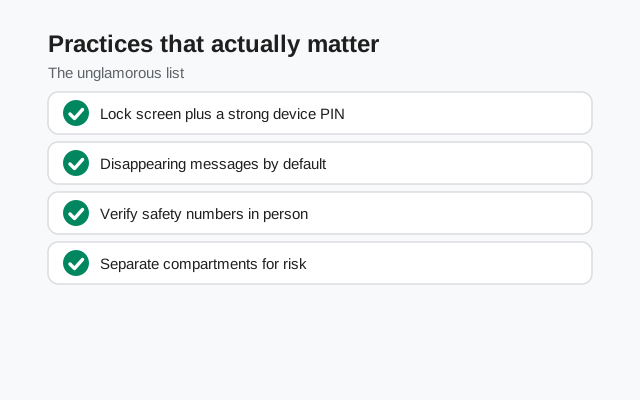
Disappearing messages on every sensitive conversation
The app is the easy part; the practices are where safety is actually won or lost. Start with disappearing messages on every sensitive conversation, set to the shortest timer the conversation can tolerate. A one-week timer is a reasonable default for organizing work; a day or less for anything genuinely sensitive. Remember that disappearing messages are a hygiene measure, not a guarantee: the other person can still screenshot or photograph the screen before the timer fires. They shrink the seizure window; they do not make messages unrecordable.
Verify safety numbers
Verify safety numbers with the people who matter. When you start a sensitive conversation, or when Signal warns you that a contact's safety number changed, verify through a second channel: a voice call where you recognize the voice, or in person. An unverified safety number means you are trusting that the encryption keys belong to the right person without checking. Our safety numbers guide explains the mechanics. Make it a habit, not a one-time setup.
Practice compartmentalization
Practice compartmentalization. Do not run your entire activist life, your family chats, and your work groups on the same account and the same device if the stakes are high. Separate accounts or devices for separate roles mean a compromise of one does not cascade into all of them. Keep sensitive groups small and purposeful; every additional member is an additional endpoint you do not control. And keep the app updated: the website build updates itself, and updates frequently include security fixes that only protect you if installed.
Lock down the device layer
Lock down the device layer. Enable Signal's screen lock with a short timeout, turn on registration lock so a SIM swap cannot take the account, and set a strong device passcode rather than biometrics if compelled unlock is a plausible threat. Review linked devices regularly and unlink anything you do not recognize. Back up nothing sensitive to clouds you do not control. None of this is exciting, and all of it is the difference between a theoretical security model and a real one.
Myths vs reality
The information-gain element for this page: the myths that get activists in trouble, corrected.
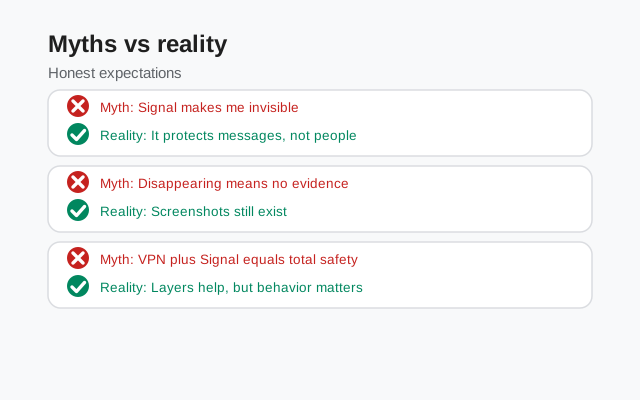
| Myth | Reality |
|---|---|
| "Signal is NSA-proof" | No consumer app is proof against a top-tier intelligence agency with endpoint access. Signal raises the cost enormously, but "proof" is a fantasy that breeds carelessness |
| "Disappearing messages mean no evidence" | They reduce the seizure window, but the other party can screenshot, photograph, or quote messages before they vanish |
| "Deleting the app deletes everything" | Uninstalling removes local data, but messages already delivered live on recipients' devices, and backups may exist elsewhere |
| "A VPN plus Signal makes me anonymous" | A VPN hides your IP from your ISP, not your identity from your contacts or the phone number your account is registered to |
| "Open source means it cannot be backdoored" | Open source means the code is auditable, not that every build is verified by you. Get the app only from Signal's own page or the Play Store, and verify the signature |
| "If the app is secure, I am secure" | The app is one layer. Seized phones, pressured contacts, and visible traffic patterns are where real compromises happen |
The through-line of every myth is the same: confusing the security of the cryptography with the security of the situation. Signal's cryptography is genuinely excellent and genuinely the best default choice. Everything around the cryptography, the phone, the people, the network, the law, is your responsibility, and no download changes that. Activists who internalize the distinction use Signal well. Activists who believe the myths use it carelessly, which is worse than not using it at all, because carelessness feels like safety.
from Signal's official site — file hosted by Signal, not by us
Frequently asked questions
Is Signal safe for activists?
Yes, it is the standard recommendation: real end-to-end encryption, minimal stored metadata, and disappearing messages. But it cannot protect an unlocked seized phone, a compromised contact, or visible network patterns. Pair the app with good operational practices.
Can the government read my Signal messages?
No, not from Signal's servers: message content is end-to-end encrypted and Signal does not have it to hand over. They can, however, read messages on a seized unlocked phone, or compel access depending on local law.
Is Signal better than WhatsApp or Telegram for activists?
For encryption by default and minimal metadata, yes. WhatsApp shares metadata with its parent company's ad business, and Telegram's default chats are not end-to-end encrypted at all.
Do disappearing messages really delete everything?
They delete messages from devices after the timer, which shrinks the seizure window. They do not stop the other person from screenshotting or photographing messages first.
Should activists use a VPN with Signal?
A VPN hides your traffic pattern from your local network, which helps in some contexts, and Signal also offers built-in proxy support for censored regions. Neither makes you anonymous to your contacts or replaces good device hygiene.
Keep reading
- Signal's threat model explained: what the app is and isn't designed to defend against
- government data requests to Signal: what authorities can actually obtain
- the Signal privacy checklist: every protective setting in one place