
Signal for legal teams: encrypted chat meets records duty
Published: October 7, 2026 · Updated: October 8, 2026
Lawyers like Signal for the obvious reason: client conversations stay private by design, with end-to-end encryption and almost no metadata trail. But law firms also live under records duties, litigation holds, and ethics rules that assume communications can be produced when required. Signal keeps no central archive and offers no retention controls, which puts its strengths and a firm's duties in direct tension. This guide lays out where Signal genuinely helps legal work, where it creates risk, and why the final call belongs to counsel, not to an app. We are not lawyers; nothing here is legal advice.
from Signal's official site — file hosted by Signal, not by us
Where Signal genuinely helps legal work
Start with the legitimate uses, because they are real. Lawyers routinely need to talk to clients about matters that must stay confidential: strategy, settlement positions, sensitive facts. On an ordinary carrier SMS or an ad-supported messenger, those conversations travel through systems built to monetize data. On Signal, message contents are end-to-end encrypted, the service stores almost nothing about the conversation, and sealed sender obscures who is talking to whom from the service itself. For a lawyer, that is not paranoia; it is competence in protecting client confidences.
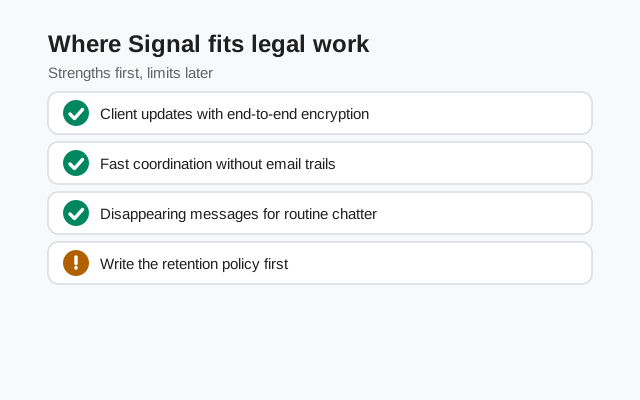
International and cross-border work is another natural fit. A lawyer coordinating with a client or co-counsel in a jurisdiction with aggressive surveillance gets meaningful protection from encryption in transit, and Signal works the same everywhere without per-country configuration. Quick coordination, "call me in ten minutes," document "send the draft to this chat," also benefits: it is fast, it is private, and it does not require either side to adopt enterprise software.
Client intake is a third use worth naming. A prospective client reaching out about a sensitive matter can contact the firm through a Signal username without exposing their phone number to the office, and the firm can respond without putting its own numbers in circulation. The business teams guide covers usernames for client contact; for firms, the privacy framing is the point.
Attorney-client communication over encryption
Encryption and privilege are different things, and confusing them causes trouble. Attorney-client privilege is a legal doctrine about what must be disclosed in proceedings; encryption is a technical property about who can read data in transit. Signal provides the second. It does nothing, by itself, to establish or protect the first.
What encryption does do is reduce the ways a privileged conversation can leak. A privileged call on an unencrypted line can be intercepted; the same conversation over Signal's end-to-end encrypted call cannot be read off the wire. That is a genuine improvement in the duty to safeguard client information, and many lawyers adopt Signal precisely for this reason. But privilege can still be waived by the oldest means available: forwarding the chat, screenshotting it, discussing it with a third party, or storing it somewhere unprotected. The app guards the pipe; the lawyer guards the privilege.
Two practical consequences follow. First, treat Signal conversations with the same privilege hygiene as email: no third parties in the thread, no casual forwarding, and clear labeling of what is privileged where your practice requires it. Second, remember that the other endpoint matters as much as yours. A privileged chat with a client whose phone is shared with family members, or whose device has no lock screen, is privileged in law and exposed in fact. Client guidance on device basics is part of the job when you move sensitive talk to a phone.
The retention and litigation-hold problem
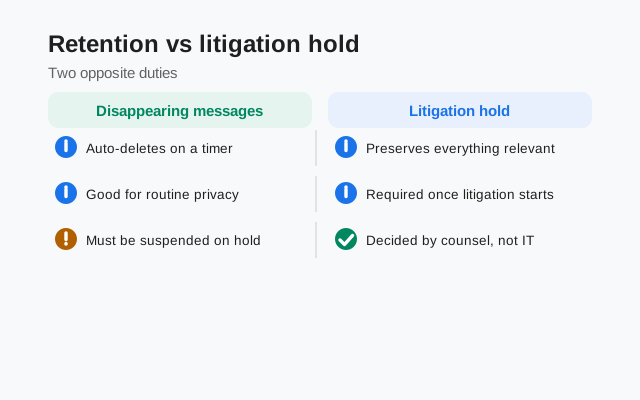
This is the section that matters most, so here it is without softening. Signal is not a records-retention system. Messages live on devices. There is no central archive, no admin export, no retention policy to configure, and no litigation-hold switch. When a litigation hold or regulatory preservation duty attaches, a firm using Signal has a problem: the duty says preserve, and the tool's design says scatter.
Disappearing messages under a preservation duty
Disappearing messages turn this from a gap into a hazard. In ordinary life they are a privacy feature. In a firm under preservation duties, auto-deletion can look like the destruction of evidence, and in some settings regulators and courts have taken a very dim view of ephemeral messaging in regulated contexts. The intent behind the timer does not matter as much as lawyers wish it did; what matters is that records which should have existed do not. If your firm or your clients operate under retention rules, litigation holds, or regulatory archiving requirements, disappearing messages should be off for work conversations, and that should be written policy, not personal preference.
The workable line: records stay out of Signal
The workable line is the same one drawn across this whole business section: decide in advance which conversations are records and keep them out of Signal. Engagement letters, advice, settlement authority, anything the file might one day need, belongs in email or the document management system, where retention and holds actually function. Signal is for coordination around the record, not for the record itself. Firms that blur this line discover the problem at the worst possible moment: when someone asks them to produce what they cannot produce. The compliance notes go deeper on records duties.
Ethics and regulatory attention
Keep this section general, because rules vary by jurisdiction and we are not your counsel. The pattern across jurisdictions is consistent enough to describe: bar and ethics rules increasingly address how lawyers communicate electronically, and the themes are competence with technology, safeguarding client information, and supervision of the systems the firm uses. A lawyer who adopts an encrypted messenger for client work should understand it well enough to advise the client on its limits, which is part of why this guide exists.
Regulators outside the legal profession have also noticed ephemeral messaging. Financial regulators in several jurisdictions have penalized firms whose staff used auto-deleting chats for business that should have been archived. The lesson for law firms is not about any single rule; it is that "the messages delete themselves" is not a defense when records were required. If your practice touches regulated clients, assume their retention duties constrain your tool choices too, and get the question answered by counsel before the tool is adopted, not during an examination.
Document the firm's decision. A short written policy, which tools are approved for client communication, what the retention settings are, who decided, and when, is both good practice and evidence of reasonable care. If the question ever arises, "we thought about this and wrote it down" is a far better position than "we just started using it."
A practical policy for firms that use Signal
For firms that decide Signal has a place, here is a policy shape that keeps the benefits while containing the risks. Adapt it; do not adopt it blindly.
Define the permitted uses in writing
List what Signal is for: quick coordination, scheduling, encrypted calls, intake contact. List what it is not for: legal advice in writing, settlement authority, engagement terms, anything the file needs. The list is the policy.
Disappearing messages off for work
Default work chats to no auto-deletion. If individual lawyers want timers for purely logistical threads, that is a documented exception, not the default. Never use disappearing messages to avoid creating records.
Usernames for client contact, numbers hidden
Set up firm usernames, lock down number-privacy settings, and publish the username where clients find contact details. Verify safety numbers with clients at the start of sensitive matters.
Move records out of chat the same day
Anything said in Signal that the file needs gets summarized into email or the DMS promptly. "The chat said it" is not a filing system.
Offboarding is manual and immediate
Departing lawyers and staff are removed from every group on day one, work chats are deleted from firm devices, and shared contacts are reviewed. No admin console means no automation; the checklist is the control.
Review annually
Tools change, rules change, matters change. Revisit the policy yearly and after any incident. A policy nobody re-reads is decoration.
What Signal can't do for you
The limits, legal edition.
Signal cannot create or preserve privilege. It encrypts the channel; privilege is a legal doctrine maintained by behavior. Forwarding, screenshots, and third parties in the thread defeat privilege regardless of encryption.
Signal cannot satisfy retention or litigation-hold duties. No archive, no export, no hold switch. If the duty exists, the records must live in systems built for records.
Signal cannot supervise your staff's communications. No admin console, no monitoring, no audit trail. The firm's supervision duty has to be met with policy, training, and culture, because the tool provides no visibility.
Signal cannot verify identity. A client contact is whoever holds the keys to that account. Verify safety numbers at the start of sensitive matters and re-verify when the app warns of a key change; impersonation of clients and lawyers is a real attack.
Signal cannot advise you on your jurisdiction's rules. Ethics opinions, retention statutes, and shield doctrines differ by place and change over time. This guide is general information. Your counsel's advice governs.
Why counsel decides
A note on who this page is for. If you are the lawyer deciding whether your firm uses Signal, you are also the person who should be making this decision carefully because you understand your jurisdiction's rules and your clients' duties. If you are staff, an IT consultant, or a client suggesting Signal to your lawyer, the right move is to raise it and let counsel decide.
The decision framework is short. First, map the firm's retention and preservation duties; if they are significant, Signal's role shrinks to coordination only. Second, check the jurisdiction's ethics guidance on electronic communication and ephemeral messaging. Third, weigh the genuine confidentiality benefit against the supervision and records cost. Fourth, write the policy before rollout, not after.
| Step | What to decide |
|---|---|
| 1. Map the duties | If retention and preservation duties are significant, Signal stays a coordination tool only. |
| 2. Check the ethics guidance | Read your jurisdiction's guidance on electronic communication and ephemeral messaging. |
| 3. Weigh benefit against cost | Compare the genuine confidentiality benefit with the supervision and records cost. |
| 4. Write the policy first | Put the policy in writing before rollout, not after. |
Firms that do this work end up with a tool that helps; firms that skip it end up with a risk they discovered too late.
And the disclaimer, stated plainly because it matters: we are not lawyers and this is not legal advice. This page describes how a tool works and where its design collides with common legal duties. Your jurisdiction, your practice area, and your clients' obligations determine what you should actually do. When in doubt, the answer is a conversation with counsel, not a settings screen.
Frequently asked questions
Can lawyers use Signal with clients?
Yes, many do, mainly for confidential coordination and encrypted calls. But privilege is a legal doctrine, not a technical feature: the app encrypts the channel, while the lawyer's behavior protects the privilege.
Does Signal satisfy law-firm record-keeping duties?
No. Signal keeps no central archive and offers no retention controls or litigation-hold features. Anything the file might need belongs in email or a document management system, not in chat.
Should a firm enable disappearing messages?
For work conversations under any retention duty, no. Auto-deletion can conflict with preservation obligations and look like evidence destruction. Keep timers off for work chats as written policy.
Is this page legal advice?
No. We are not lawyers. Rules on electronic communication, retention, and privilege vary by jurisdiction. Treat this as general information and get counsel's advice for your situation.
How should a firm handle a lawyer leaving?
Manually and immediately: remove them from every group, delete work chats from firm devices, and review shared contacts. There is no central deprovisioning, so keep a written offboarding checklist.
Keep reading
- the compliance notes for regulated teams
- how disappearing messages really behave
- the general business teams guide
- what police can actually get from Signal