
Signal vs Messenger: an Honest Comparison
Published: October 7, 2026 · Updated: October 8, 2026
This is the comparison where honesty cuts both ways. It is easy to paint Messenger as the villain and Signal as the saint, and on privacy structure that is roughly how it lands. But Messenger is also a genuinely good product that hundreds of millions of people enjoy using, and pretending otherwise would be dishonest. So this page gives Messenger its real credit first, then explains why the privacy gap is structural and not fixable with a settings toggle.
from Signal's official site — file hosted by Signal, not by us
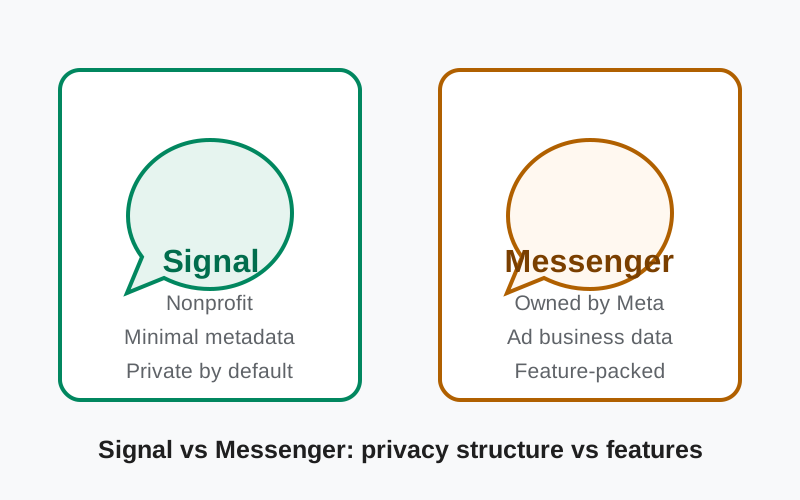
The two apps, side by side
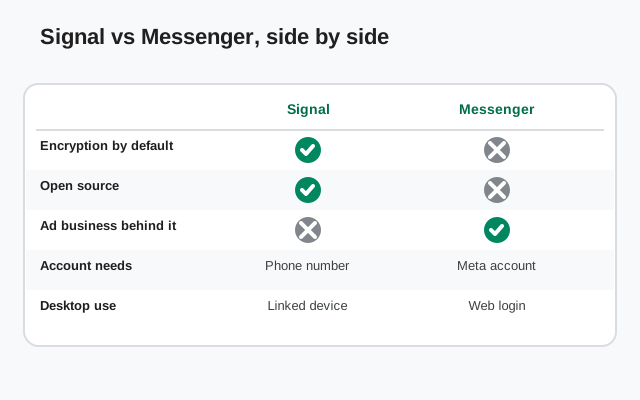
| Signal | Facebook Messenger | |
| Owner | Signal Foundation, a US nonprofit | Meta, one of the world's largest advertising companies |
| Business model | Donations and grants; no ads, no data business | Free to users; supports Meta's advertising business |
| Chat encryption | End-to-end encrypted by default, every chat and call | End-to-end encrypted by default for personal chats after Meta's rollout; previously opt-in |
| Open source | Client app open source; server code published | Closed source |
| Metadata collected | Minimal by design | Extensive: Meta documents collection of usage, device, and contact data across its services |
| Registration | Phone number (usernames hide it from contacts) | Facebook account or phone number |
| Fun features | Essentials covered; not the focus | Games, effects, stickers, chat themes, and constant new toys |
| Network | Large and growing | Huge: tied to Facebook's social graph |
| Desktop | Linked desktop app | Web, desktop apps, and deep Facebook integration |
The encryption row needs unpacking, because "default" on Messenger has a history. That history is the next section.
Encryption: the default vs opt-in story
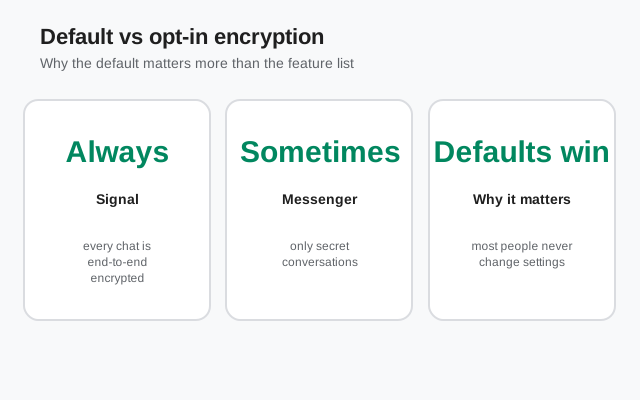
Signal: encrypted from day one
Signal has been end-to-end encrypted by default since the beginning. Every chat, every group, every call. There was never a version of Signal where your messages were readable by the company, and there is no setting to turn the encryption off. It is not a feature; it is the foundation.
Messenger: encryption was the exception
Messenger's story is the opposite. For most of its life, Messenger chats were not end-to-end encrypted at all. Messages were encrypted in transit and stored on Meta's servers in readable form, which is how features like server-side search and multi-device sync worked so smoothly. End-to-end encryption existed only as "secret conversations," an opt-in mode most users never touched, with fewer features and an air of paranoia about it.
What default encryption changed, and what it did not
Meta then announced and rolled out default end-to-end encryption for personal chats on Messenger. That is a genuine improvement and worth acknowledging: the content of your personal chats is now protected from Meta and outsiders in a way it was not before. But notice what default encryption does and does not change. It protects message content. It does not change who owns the app, what metadata gets collected, or what the company's business model does with that metadata. An encrypted chat inside an advertising company's data machine is better than an unencrypted one, but it is not the same as a chat inside a machine that was built to know nothing.
Verification: safety numbers vs trust
There is also the question of verification. Signal gives you safety numbers to confirm your contact's identity and warns you when keys change. Messenger's encryption offers no equivalent user-facing verification ritual. You trust Meta's implementation, which is closed source. Trust in Meta on privacy matters is, to put it gently, a harder sell than trust in a nonprofit whose code you can read.
The business-chat exception
One more honest detail: default encryption covers personal chats, but not everything in the app. Conversations with businesses, which Messenger is heavily built around, and interactions with Meta's AI features follow different data terms than personal chats. That is not hidden, it is in the fine print, but most users never read fine print. On Signal there is no fine print to read: there are no business chats and no AI assistant, so there is no second set of rules. The simplicity is the guarantee.
Metadata and the advertising business
The debate was never about message content
If you take one idea from this page, take this: the Messenger vs Signal debate was never really about message content. It is about metadata. Meta's business is understanding people well enough to sell predictions about them to advertisers. Everything Meta builds serves that business, and Messenger is one of its richest data sources.
What Meta collects
Meta's own privacy documentation describes broad collection across its products: how you use the apps, information about your devices and connections, your contacts and social connections, and activity across Meta's family of apps and websites. Messenger feeds this picture: who you talk to, when, how often, from where, on what device, alongside your Facebook social graph, your Instagram activity, and everything else Meta knows. No single piece is your message content. Together, they are a detailed model of your life, and that model is the product Meta sells.
What Signal keeps
Signal, by contrast, is engineered to have almost nothing to feed anyone. Its public statements and its responses to government requests point the same way: it keeps your number, account dates, and last connection time, and not your contacts, your groups, or who you messaged. Our Signal metadata guide and is Signal really private go deeper on what minimal actually means.
The business model is the gap
Could Meta stop collecting all of this tomorrow? In theory. In practice, asking an advertising company to stop collecting data is asking it to stop being itself. The collection is not a bug in Messenger; it is the business model working as designed. That is why no encryption rollout, however welcome, closes this gap.
Features: where Messenger honestly wins
Now the other side of the honesty. Messenger is, by most measures of fun and convenience, the better product. Saying so does not weaken the privacy case; it strengthens the comparison's credibility. Here is where Messenger genuinely wins:
- Fun factor. Games you can play inside chats, AR effects, stickers, GIF integration, chat themes, emoji reactions with personality. Messenger feels like a playground; Signal feels like a well-lit office. Both have their place, but only one is fun.
- Social graph. Messenger knows who your friends are because Facebook knows. Starting a chat takes seconds, group chats assemble themselves, and you never face the "is anyone I know on here?" problem that every Signal newcomer hits.
- Integration. Messenger lives inside Facebook, has a full web client, desktop apps, and hooks into Instagram messaging. It is everywhere you already are.
- Business and commerce. Businesses chat with customers on Messenger, with catalogs, booking, and support flows. Signal has nothing for businesses, by design.
- Features velocity. Meta ships new Messenger features constantly. Signal ships carefully and slowly, because every feature is weighed against the privacy cost.
Signal's honest wins are fewer but structural: real privacy by default, verifiable open-source code, usernames that hide your phone number, and no ads or engagement machinery trying to keep you scrolling. Our Signal vs WhatsApp comparison covers similar ground against Meta's other messenger, if you want the full picture of Meta's messaging empire.
The trade is therefore clear and fair: Messenger gives you more fun and more convenience, and charges you in data. Signal gives you privacy and charges you nothing, but asks you to accept a simpler app and a smaller network. Neither side of that trade is irrational. What would be irrational is pretending the trade does not exist.
Who should pick which
| Your situation | The honest pick |
|---|---|
| You want maximum privacy from the company itself | Signal. Nonprofit, minimal metadata, open code. This is what it was built for. |
| All your friends and family are on Messenger | Messenger for daily life; keep Signal for private conversations. Using both is normal. |
| You love the fun features: games, effects, themes | Messenger. Signal does not try to compete here and never will. |
| You chat with businesses or sell things | Messenger. Signal has no business tools at all. |
| You are a journalist, activist, or handle sensitive work | Signal. Minimal metadata plus verifiable code is the safer combination. |
| You want to hide your phone number | Signal (usernames). Messenger ties you to your Facebook identity or number. |
| You distrust Meta's data collection specifically | Signal. No Meta account, no Meta graph, no ad business. |
"Use both" deserves repeating. In practice, privacy-conscious people in Messenger-heavy circles do exactly this: Messenger for the social world as it is, Signal for the conversations that matter. There is no prize for purity, and a messenger nobody answers is not private, it is just quiet.
If you decide Signal earns a place on your phone and the Play Store is not available, our Signal APK download guide walks through getting the verified build straight from Signal. The current website build is version 8.29.3, and it takes a few minutes.
Frequently asked questions
Is Facebook Messenger end-to-end encrypted?
Personal chats are end-to-end encrypted by default following Meta's rollout. Previously, encryption was opt-in through secret conversations. The rollout protects message content, but Meta still collects extensive metadata around your chats.
Can Meta read my Messenger messages?
Not the content of end-to-end encrypted personal chats. But Meta documents broad collection of metadata, usage data, device information, and social graph data across its services, which feeds its advertising business.
Is Signal safer than Messenger?
For privacy from the service provider, yes. Signal is a nonprofit with minimal metadata collection and open-source code. Messenger sits inside Meta's advertising business and is closed source.
Does Messenger have more features than Signal?
Yes, honestly. Games, AR effects, chat themes, deep Facebook integration, and business messaging are real advantages. Signal focuses on private messaging essentials rather than entertainment features.
Can I use Signal and Messenger on the same phone?
Yes. They are separate apps and many people run both: Messenger for everyday social chats, Signal for private conversations.
Why did Messenger add encryption so late?
Messenger was built for features that required server-side access to messages, like search and seamless multi-device sync. Moving to default end-to-end encryption took years of re-engineering. Signal never had that legacy because encryption was its foundation.
Related guides
- All Signal comparisons: the full compare hub
- Signal vs WhatsApp: against Meta's other messenger
- Is Signal really private?: an honest privacy assessment
- WhatsApp vs Signal data collection: Meta data practices compared
- Is the Signal APK safe?: our honest safety assessment