
Signal vs WhatsApp: an Honest Comparison
Published: October 7, 2026 · Updated: October 8, 2026
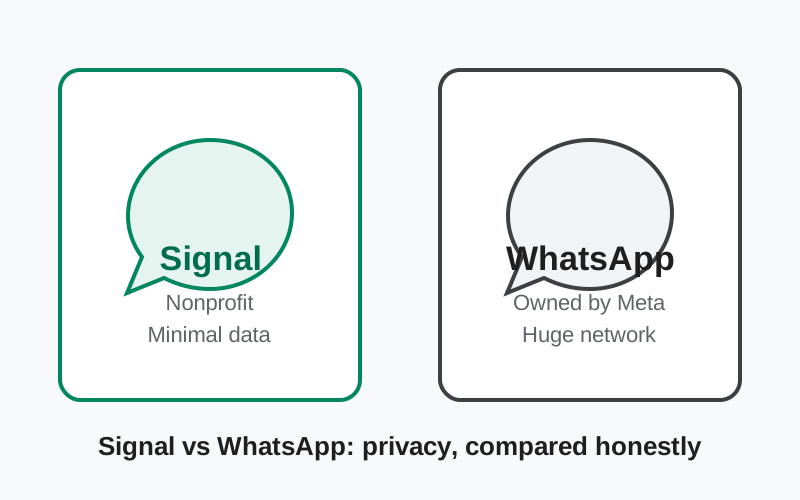
Ask this question in any tech group and you will get two extreme answers. One side says WhatsApp is spyware and Signal is the only moral choice. The other side says both use the same encryption so there is no difference at all. Both answers are wrong, and both hide the truth in the same way: they reduce a real trade-off to a slogan. The encryption really is similar. Almost everything else, from the business model to the data sitting around your messages, is different.
from Signal's official site — file hosted by Signal, not by us
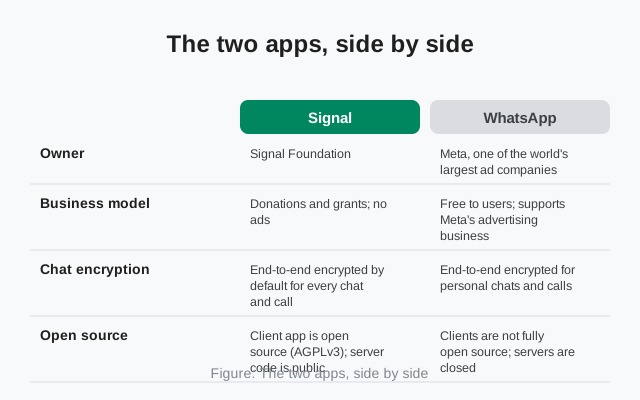
The two apps, side by side
| Signal | ||
| Owner | Signal Foundation, a US nonprofit | Meta, one of the world's largest ad companies |
| Business model | Donations and grants; no ads, no data business | Free to users; supports Meta's advertising business |
| Chat encryption | End-to-end encrypted by default for every chat and call, using the Signal Protocol | End-to-end encrypted for personal chats and calls, using the Signal Protocol |
| Open source | Client app is open source (AGPLv3); server code is public | Clients are not fully open source; servers are closed |
| Metadata collected | Minimal by design: Signal states it keeps almost nothing about who talks to whom | Extensive: usage data, device info, contacts, and more, shared with Meta companies |
| Registration | Phone number required (usernames let you hide it from contacts) | Phone number required (no username system) |
| Network size | Large and growing, but much smaller than WhatsApp | Billions of users; the default messenger in most countries |
| Channels / communities | No broadcast channels; groups only | Channels, Communities, and large groups |
| Business messaging | No business platform | Large WhatsApp Business ecosystem (business chats have different terms) |
| Payments | None built in | Available in some countries |
A table can only take you so far. The rows that matter most for your decision are encryption, ownership, metadata, and features, and each deserves more than one line.
The encryption surprise: more alike than you think
Here is the part Signal fans sometimes leave out: WhatsApp adopted the Signal Protocol back in 2014 and rolled it out to every user by 2016. Your one-to-one chats and group chats on WhatsApp are end-to-end encrypted with the same family of cryptography that Signal uses. Meta cannot read the content of those messages. That is not marketing; it is independently understood cryptography, and security researchers treat WhatsApp's personal chat encryption as genuinely strong.
So if someone tells you WhatsApp messages are "not encrypted," they are wrong. The correct statement is narrower: the content is encrypted, but almost everything around the content is not private at all. That is where the two apps genuinely diverge, and it is a bigger deal than most people realize.
Where WhatsApp is genuinely strong
It would be dishonest to pretend Signal wins on everything. WhatsApp has real, concrete advantages, and for many people they outweigh the privacy concerns.
Everyone is already there. This is WhatsApp's single biggest advantage and it is not close. In most of the world, WhatsApp is not an app you choose; it is the phone's default communication layer. Your family group, your kid's school parents' group, your landlord, your delivery driver, your doctor's receptionist: they are on WhatsApp. A messenger with nobody to talk to is a very private paperweight, and network effect is a legitimate feature.
Features, breadth, and polish. WhatsApp ships like a consumer product because it is one:
- Channels for following creators
- Communities for organizing many groups
- A business platform with catalogs and payments
- Voice and video calls that work well at huge scale
- Status updates, stickers, and polls
- Genuinely good multi-device support that no longer needs your phone to be online
Signal covers the messaging essentials well but does not try to be a platform, and the difference shows.
Onboarding friction is near zero. Install, verify your number, and your contacts are already there. For less technical family members, this matters more than any cryptography discussion ever will.
None of this makes WhatsApp the privacy pick. It makes it the practical pick for a lot of people, and there is nothing wrong with admitting that.
Where Signal is genuinely stronger
Signal's advantages are structural, not cosmetic. They come from how the organization is built and what it chose not to collect.
A nonprofit with nothing to sell you
Signal Foundation is a nonprofit. It has no advertisers, no data brokerage, no growth team trying to increase your screen time for someone else's benefit. WhatsApp is excellent at what it does, but what it does includes feeding Meta's understanding of you. When the business model is privacy, privacy tends to win. When the business model is advertising, advertising tends to win. This is not about good or evil people; it is about incentives.
Open source, so claims can be checked
Signal's Android client is open source, and its server code is published too. Independent researchers can and do read it. WhatsApp's clients are not fully open source and its servers are closed, so its privacy claims rest on trust in Meta. Trust is not worthless, but verification is better.
Encryption everywhere, not just in chats
Signal encrypts end to end by default across chats, group chats, voice calls, and video calls. There are no special chat types where the rules quietly change. On WhatsApp, personal chats are encrypted, but conversations with businesses can be handled differently, and the app keeps nudging you toward Meta AI features whose data handling follows different terms.
Thoughtful details
Signal shows safety numbers so you can verify a contact's identity and catch man-in-the-middle attacks. Sealed Sender hides who is messaging whom from Signal's own servers. Registration lock (a PIN) protects your number from SIM-swap account theft. These are the details of an app built by people whose threat model includes the server operator, not just outside attackers.
Metadata: the difference that actually matters
Privacy discussions love to focus on message content, because that is what feels intimate. But the metadata around your messages, who you talk to, when, how often, from where, on what device, is often more revealing than the words. A year's worth of "called this number at 2am, every night" tells a story no single message could.
Signal is engineered to have almost nothing to give. Its public statements and its responses to government requests both point the same way: it stores your phone number, registration dates, and the last time you connected, and not your contacts, not your groups, not who you messaged. When governments have asked for user data, that is essentially all there was to hand over.
WhatsApp, by its own privacy policy, collects far more: your usage patterns, device and connection information, your contacts (if you grant access), status changes, and diagnostics, and it shares information with other Meta companies. Meta uses this to run its business. The company is open about this; it is written in the policy most people never read.
Does this metadata collection let Meta read your messages? No. Does it let Meta build a detailed picture of your social graph, habits, and movements? Yes, and that picture is valuable to an advertising company in ways it is not valuable to a nonprofit. If you only take one thing from this page, take this: the Signal vs WhatsApp debate is a metadata debate, not an encryption debate.
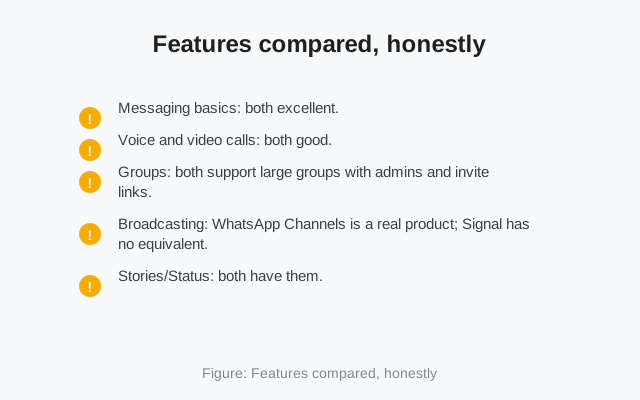
Features compared, honestly
Strip away the ideology and compare what you can actually do with each app:
- Messaging basics: both excellent. Text, voice notes, photos, video, documents, reactions, replies, disappearing messages. No meaningful gap.
- Voice and video calls: both good. WhatsApp has more experience at massive scale; Signal's calls are end-to-end encrypted including group calls, and call links let people join without a group.
- Groups: both support large groups with admins and invite links. WhatsApp adds Communities for organizing related groups, which Signal does not offer.
- Broadcasting: WhatsApp Channels is a real product; Signal has no equivalent. If you follow creators or run announcements, this is a genuine WhatsApp advantage.
- Stories/Status: both have them. Signal's stories are private to your chosen audience; WhatsApp Status reaches your contacts broadly.
- Business use: WhatsApp Business is a whole ecosystem. Signal has nothing for businesses, by design.
- Usernames: Signal lets you create a username and share it instead of your phone number. WhatsApp still ties your identity to your number everywhere.
- Desktop and web: both offer linked desktop apps. WhatsApp's multi-device system is more mature; Signal's works fine but historically required the phone to stay in the loop.
The pattern: WhatsApp is the richer product. Signal is the more private one. Neither is trying to be the other, and judging either by the other's goals misses the point.
Backups: who holds your history
Backups are where good encryption goes to die, so they deserve attention. Signal offers encrypted backups: a local encrypted backup file on Android and its newer Secure Backups service, both protected by a passphrase or recovery key that only you hold. If you lose the key, nobody, not even Signal, can restore your chats. That is the price of real encryption, and Signal is honest about it.
WhatsApp offers optional end-to-end encrypted backups protected by a password or a 64-digit key. The important word is optional. Historically, WhatsApp backups to Google Drive or iCloud were not end-to-end encrypted, meaning your chat history sat readable on someone else's cloud. WhatsApp now pushes users toward the encrypted option, which is a genuine improvement, but the default path of least resistance was unencrypted for years, and many users never changed it.
Practical advice for both apps: turn on the encrypted backup option, write down the key somewhere safe (a password manager, not a screenshot), and understand that losing the key means losing the history. That is true on Signal and on WhatsApp alike.
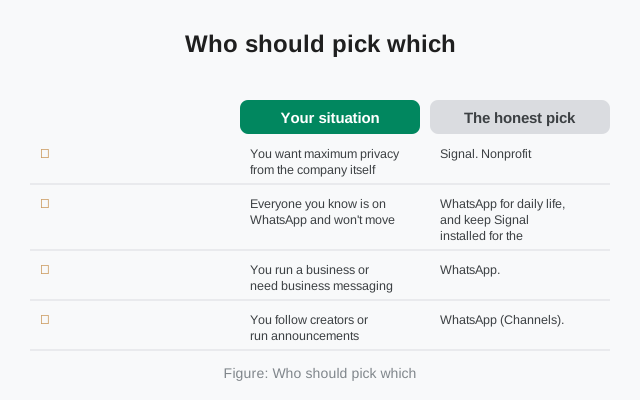
Who should pick which
| Your situation | The honest pick |
|---|---|
| You want maximum privacy from the company itself | Signal. Nonprofit, minimal metadata, open source. This is what it was built for. |
| Everyone you know is on WhatsApp and won't move | WhatsApp for daily life, and keep Signal installed for the contacts who care. Using both is normal and fine. |
| You run a business or need business messaging | WhatsApp. Signal has no business tools at all. |
| You follow creators or run announcements | WhatsApp (Channels). Signal has no broadcast feature. |
| You are a journalist, activist, or handle sensitive work | Signal. Minimal metadata plus open source is the safer combination. |
| You want to hide your phone number from new contacts | Signal (usernames). WhatsApp exposes your number to everyone you chat with. |
| You just want the simplest thing that works for family | WhatsApp. Zero friction beats perfect privacy for most families. |
Notice that "use both" appears more than once. That is not a cop-out; it is what privacy-conscious people in WhatsApp-dominated countries actually do. WhatsApp for the world as it is, Signal for the conversations that matter.
If you decide Signal is for you and your phone lacks the Play Store, grab the official build straight from Signal: our Signal APK download guide walks through verifying it. And if you are curious how Signal's direct APK differs from the Play Store version, the APK vs Play Store comparison covers that.
Frequently asked questions
Is WhatsApp end-to-end encrypted?
Yes, for personal chats and calls. WhatsApp uses the Signal Protocol, the same cryptography family Signal uses, so message content is protected from Meta and outsiders. The privacy concern with WhatsApp is metadata collection, not message encryption.
Can Meta read my WhatsApp messages?
Not the content of your personal chats; those are end-to-end encrypted. But Meta does collect extensive metadata (who you contact, when, device info) and shares data across its companies for its advertising business. Business chats and Meta AI interactions follow different terms.
Is Signal really safer than WhatsApp?
For privacy from the service provider, yes. Signal is a nonprofit that collects minimal metadata and publishes its code, while WhatsApp feeds metadata into Meta's ad business and keeps its servers closed. For protection of message content from outsiders, both are strong.
Can I use Signal and WhatsApp on the same phone?
Yes. They are separate apps with separate accounts on the same phone number, and many people run both: WhatsApp for everyday contacts, Signal for private conversations.
Which app is better for groups?
WhatsApp, for most people: Communities, larger ecosystem, and everyone is already there. Signal's groups are fully encrypted and work well, but lack the organizational features WhatsApp offers.
Does Signal have ads?
No. Signal has no ads, no trackers, and no data business. It is funded by donations and grants to the nonprofit Signal Foundation.
Related guides
- All Signal comparisons: the full compare hub
- Signal APK vs Play Store build: the two official Signal builds
- Is the Signal APK safe?: honest safety assessment
- Download the official Signal APK: verified download walkthrough
- Signal vs Viber: another mainstream chat app, compared honestly
- WhatsApp APK vs Signal APK: the official download channels, compared