
Signal Payments in 2026: What You Can Actually Do
Published: October 7, 2026 · Updated: October 8, 2026
Search 'signal payments' and you will find a confusing mix: old headlines about a crypto launch, forum posts asking where the button went, and scam sites promising a 'Signal coin.' This page clears it up with the verifiable history:
- what Signal actually built
- why it never became a payments product
- what (little) exists in 2026
- how to actually support Signal's nonprofit mission with a donation
- how to avoid the payment-themed scams floating around
from Signal's official site — file hosted by Signal, not by us
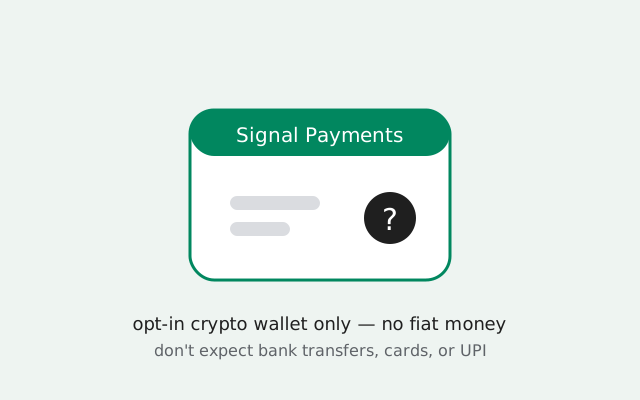
What Signal Payments actually was
In April 2021, Signal announced it was testing a feature called Signal Payments: a way to link a MobileCoin wallet to Signal and send the MobileCoin currency (MOB) to contacts. The design goal was explicit: payments that were fast, private, and worked well on mobile, matching Signal's privacy philosophy. Signal stated at the time that it had no access to users' balances, transaction history, or funds, and that users could move their funds to another wallet any time.
Key facts about the launch, all from Signal's own announcement and the press coverage of it:
- It was a beta, in a beta build. Signal framed it as an experiment and asked users to help test it and give feedback.
- It started UK-only. The first rollout was limited to users in the United Kingdom, with Signal saying it would expand to other regions over time.
- One currency only. The first (and only) payments protocol Signal added support for was MobileCoin, a privacy-focused cryptocurrency with its own currency, MOB.
- Fully opt-in. Nothing about it was mandatory or even prominent. You had to go looking for it in settings to enable it.
That is the complete product definition. It was never "send money to anyone like a bank app." It was always a niche crypto wallet tucked inside a messenger.
The short, honest timeline
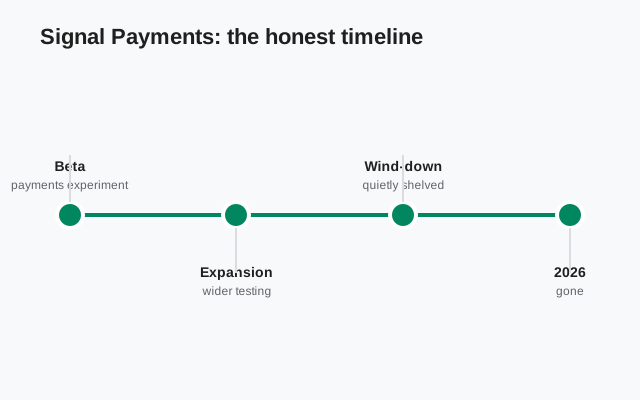
- April 2021: Signal announces Signal Payments in beta, UK-only, built on MobileCoin (MOB).
- 2021-2022: The feature expands to more regions and ships in the main app as an opt-in setting. Press coverage moves on; adoption stays tiny.
- 2022: Signal's founder steps down as CEO. The payments experiment loses its most prominent internal champion.
- 2023: The MobileCoin Foundation rebrands to Sentz, pivoting toward a savings product. The crypto at the heart of Signal Payments is now a different company with a different focus.
- 2024-2026: Development on the payment layer goes quiet. The option remains in Signal's settings, still opt-in, still MobileCoin-based. A fraction of a fraction of users ever touch it.
Nobody "killed" the feature with a press release. It simply never grew up: it stayed an opt-in beta-shaped feature for five years while the rest of the app shipped hundreds of updates. That silence is the status.
What exists in 2026
As of 2026, the honest status is this:
- The opt-in MobileCoin wallet still exists in Signal's settings. You can enable it and send MOB to contacts who also enable it. That is the full extent of in-app money movement.
- Almost nobody uses it. It was opt-in, buried in settings, tied to a volatile cryptocurrency most people had never heard of, and never marketed. Low adoption is not a rumor; it is the visible outcome of five years.
- There is no fiat path at all. No bank transfers, no debit cards, no UPI, no mobile-money integration, no "send $10" button anywhere in the app. If you need to send real money, you need a different app.
- No public roadmap for more. Signal has not announced new payment methods, new currencies, or any expansion of the payments idea. We would not plan around one arriving.
So the 2026 answer to "can I send money on Signal?" is: only MOB, only to other opt-in users, only if you acquire MOB somewhere first. For everyone else, the answer is no.
What you cannot do (the important list)
This list matters more than the feature list, because payment expectations are where people get hurt:
- You cannot send dollars, euros, rupees, or any fiat currency in Signal. There is no conversion, no wallet balance in your currency, no cash-out.
- You cannot pay a business on Signal. No merchant payments, no invoices, no checkout.
- You cannot receive your salary or freelance payments on Signal. It is not a bank account and has no account number.
- You cannot buy MOB inside Signal with a card. Acquiring the cryptocurrency is your problem, on an exchange, outside the app.
- You cannot reverse a crypto payment. Like all cryptocurrency transfers, sent MOB is sent. There is no chargeback, no support ticket that gets it back.
If any website or person tells you otherwise ("Signal now supports bank transfers," "new Signal Pay update"), it is either confusion or a scam. Which brings us to the scams section.
Why it never became a payments product
It is worth understanding why, because it explains why you should not wait for a payments revival:
- Privacy and payments are in tension. Real payment systems need identity verification, fraud detection, and regulatory compliance (KYC/AML). Signal's architecture is built to avoid knowing who you are. Those two goals collide hard.
- Regulatory weight. Handling other people's money invites financial regulation in every country you operate in. Signal is a small nonprofit; the compliance burden of a global payments product would dwarf the organization.
- The crypto choice boxed it in. Tying the feature to one obscure cryptocurrency meant it could never serve the "send $20 to mom" use case that makes in-app payments popular. WhatsApp Pay works because it moves rupees people already have; Signal Payments required acquiring MOB first.
- It was never the mission. Signal exists to make private communication normal. Payments was an experiment by an interested founder, not the product's reason for being. When he left, the experiment lost its engine.
The takeaway: Signal's payments story is a case study in a product knowing what it is not. That discipline is arguably why the messenger itself stayed excellent.
How to actually support Signal
Here is the money question with a real answer: Signal is a nonprofit, and it runs on donations. The Signal Foundation accepts donations at signal.org/donate: that is the legitimate way to put money toward Signal's mission. Donations fund the servers, the engineers, and the independence that keeps Signal free of ads and investors.
A few honest notes on supporting Signal:
- Donate at signal.org/donate. That is the real page. Any other "donate to Signal" link deserves suspicion.
- Donations are not payments to contacts. You are funding the nonprofit, not sending money to a friend. Keep the two ideas separate.
- Signal has no premium tier. There is no paid version, no "Signal Pro," no subscription that unlocks features. Anyone selling you one is scamming you.
- Word of mouth is free support. Moving your family group to Signal does more for the mission than most donations. Network effects are what keep private messengers alive.
Payment-themed scams to avoid
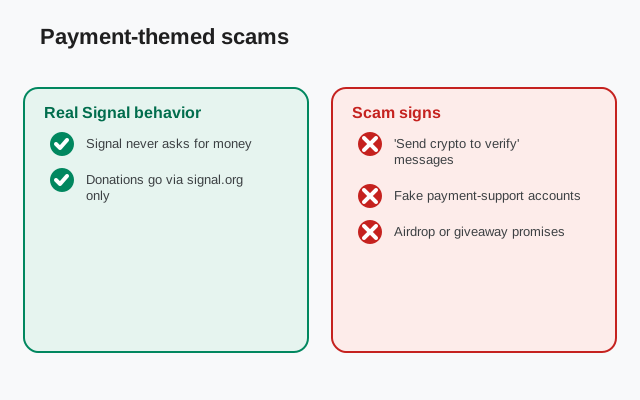
Wherever money and confusion meet, scams follow. The greatest hits around Signal payments:
- "Signal Coin" giveaways. There is no Signal coin. Any site, ad, or message offering free Signal/MOB tokens for connecting your wallet is phishing.
- Fake "Signal Pay" apps. There is no separate Signal payments app. Anything in that name is malware until proven otherwise. Our APK safety guide explains how to verify the real app.
- "Send 1 MOB, get 2 back" doubling schemes. The oldest crypto scam in the book, wearing a Signal costume. The sent coins never come back.
- Impersonators asking for payment. "This is Signal support, pay the verification fee." Signal support never asks for money, and Signal has no verification fees.
- Recovery-phrase theft. Anyone asking for your wallet's recovery phrase (for any wallet, anywhere) is stealing from you. No legitimate support flow needs it.
The rule that covers all of these: Signal will never ask you for money or crypto. Donations go to signal.org/donate, by your choice, and everything else is a scam.
Signal vs Telegram vs WhatsApp on money
| Signal | Telegram | ||
| Send fiat money in chat | No | Limited (varies by region) | Yes, in some countries (e.g. UPI-based payments where launched) |
| Crypto features | Opt-in MobileCoin (MOB) wallet; niche | Stars and TON-based features; actively developed | No native crypto |
| Merchant payments | No | Bot payments, Stars | Business payments in supported regions |
| Monetization model | Nonprofit donations | Premium subscriptions, ads, Stars | Business API, ads-adjacent |
| Bottom line | Not a payments app; do not expect money features | Actively building a money layer | Payments exist where regulators allowed them |
Offerings change, so treat this as a 2026 snapshot, not a contract. If sending money inside a chat is a core need, our Signal vs WhatsApp comparison covers which app actually serves it. If you just need the messenger itself, grab it from the only source we recommend: Signal's own APK page.
FAQ
Can I send money on Signal?
Only in a very limited way: Signal has an opt-in MobileCoin (MOB) crypto wallet in its settings. There are no bank transfers, cards, UPI, or fiat payments of any kind in Signal.
What is Signal Payments?
An opt-in feature launched in beta in April 2021 that lets users link a MobileCoin wallet and send the MOB cryptocurrency to contacts. It started UK-only, stayed niche and opt-in, and never became a mainstream payments product.
Is MobileCoin still part of Signal?
The opt-in MobileCoin wallet remains in Signal's settings as of 2026. The MobileCoin Foundation rebranded to Sentz in 2023, and development on the payment layer has been quiet since.
How can I donate to Signal?
Signal is a nonprofit funded by donations. You can donate at signal.org/donate. That is the only legitimate donation page. Beware of lookalikes.
Is there a Signal coin I can buy?
No. There is no Signal coin. Any site offering a Signal token or promising free MOB for connecting your wallet is a scam.
Does Signal have a premium or paid version?
No. Signal has no premium tier, no subscription, and no paid features. Anyone selling you Signal Pro or asking for a verification fee is scamming you.
Keep reading
- is the Signal APK safe: verify the real app and avoid fakes
- Signal vs WhatsApp comparison: which app actually does in-chat payments
- Signal vs Telegram comparison: how the two differ on money features
- download the official APK: the only source we recommend