
Signal vs Telegram: Encryption Models Compared
Published: October 7, 2026 · Updated: October 8, 2026
This is the comparison where marketing does the most damage. Telegram calls itself a secure messenger, and millions of people believe their Telegram chats are end-to-end encrypted. For the vast majority of Telegram users, they are not. Understanding exactly what each app encrypts, and what it leaves readable on a server, is the whole comparison. Everything else is secondary.
from Signal's official site — file hosted by Signal, not by us
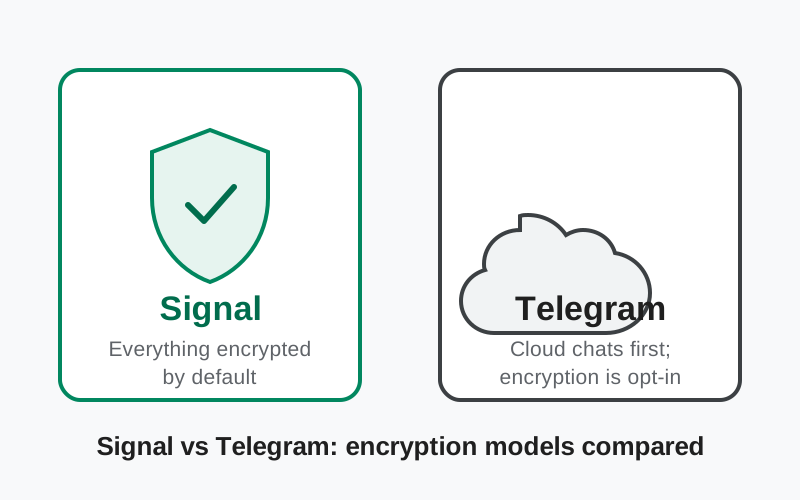
The two apps, side by side
| Signal | Telegram | |
| Default chat encryption | End-to-end encrypted, every chat | Server-client encrypted; Telegram holds readable copies |
| True end-to-end encryption | All chats, groups, and calls, always on | Only "Secret Chats" (one-to-one, opt-in, manual start) |
| Group chat encryption | End-to-end encrypted | Not end-to-end encrypted (no secret group chats) |
| Call encryption | End-to-end encrypted | End-to-end encrypted for one-to-one calls |
| Protocol | Signal Protocol: open, widely studied and audited | MTProto: custom protocol, less independent scrutiny |
| Open source | Client open source; server code public | Clients partially open; server code closed |
| Owner | Signal Foundation, a nonprofit | Telegram, a private company funded by ads and Premium subscriptions |
| Message storage | No server-side message copies; history lives on your devices | Cloud storage: full history synced on Telegram's servers |
| Channels and bots | None | Huge ecosystem: channels, bots, very large groups |
| Multi-device sync | Linked devices; history sync is limited | Seamless: log in anywhere, full history instantly |
The table looks lopsided because the privacy rows are lopsided. But Telegram's feature rows are just as lopsided in the other direction, and both halves deserve a fair hearing.
How each app actually encrypts
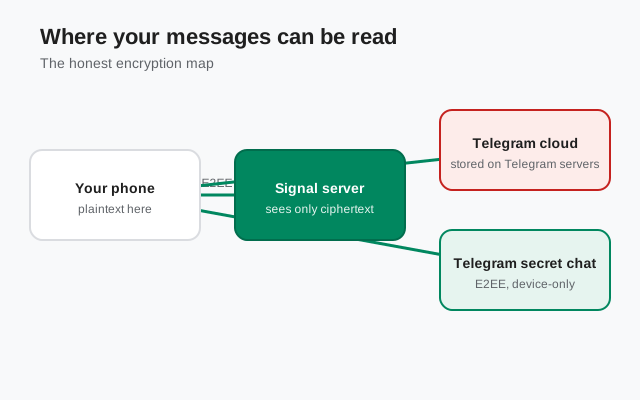
On Signal, when you send a message, it is encrypted on your phone and can only be decrypted on the recipient's phone. Signal's servers relay an unreadable blob. Signal cannot read it, a hacker who breaks into Signal's servers cannot read it, and a government with a court order cannot get the content from Signal, because Signal never had it. Groups work the same way. Calls work the same way. There is no mode to switch on and no setting to forget.
On Telegram, when you send an ordinary message, it is encrypted in transit between your phone and Telegram's servers, and then it sits on Telegram's servers in a form Telegram can read. Your chat history is stored there so you can log in from any device and see everything instantly. That cloud convenience is the product, and readable-on-the-server storage is its price. Telegram's team could read your messages, and anyone who compromises their servers or legally compels them could too.
Telegram's defenders sometimes answer that the company would never do this. That may be true of the people, but privacy should not depend on promises. Signal's design does not ask you to trust promises; the math makes the promise unnecessary. That is the philosophical gap between the two apps, and it runs deeper than any feature list.
Secret Chats: the feature comparisons bury
Telegram does offer genuine end-to-end encryption, and fairness requires describing it accurately. A Secret Chat is a one-to-one conversation with end-to-end encryption, self-destruct timers, no forwarding, and a notification if someone screenshots on Android. Used correctly, it is real privacy.
Here is the honest catch, in four parts. First, it is opt-in: you must start a Secret Chat deliberately for each contact, and almost nobody does. Second, it is one-to-one only; there is no such thing as a secret group chat, so every group conversation on Telegram is server-readable. Third, Secret Chats are tied to the device that started them; start one on your phone and it does not exist on your desktop. Fourth, the encryption uses Telegram's own MTProto protocol rather than the Signal Protocol, so it has received less independent cryptographic scrutiny than Signal's.
The result: a privacy feature that exists but that the product is not built around. Defaults matter enormously in security, because the vast majority of users never change them. Signal's default is the private one. Telegram's default is the convenient one. Judge each company by its defaults, not by its optional extras.
Where Telegram is genuinely stronger
Telegram is an outstanding product, and pretending otherwise would be dishonest. Its strengths are real and, for many use cases, decisive.
Channels and communities. Telegram invented the modern messaging-channel format that everyone else copied. Following news, creators, and communities on Telegram is a genuinely great experience, and Signal has nothing comparable. If your use case is broadcasting or following, Telegram wins outright.
Scale. Enormous groups, massive file sharing, bots that do everything from payments to games to group moderation. Telegram is a platform, not just a messenger, and its developer ecosystem is years ahead.
Cloud sync. Log into Telegram on any device and your entire history is there instantly. No backups to manage, no keys to lose, no device-linking dance. For most people, most of the time, this is pure convenience, and it is the direct result of the server-readable storage that privacy folks criticize. The trade-off is visible and honest: convenience bought with trust.
Usernames and identity flexibility. Telegram lets you chat, join groups, and run channels behind a username without exposing your phone number. Combined with the huge public ecosystem, this makes Telegram the better tool for public or semi-public communication.
Speed of development. Telegram ships features constantly. Signal moves deliberately and sometimes slowly. If you like new toys, Telegram is more fun.
Where Signal is genuinely stronger
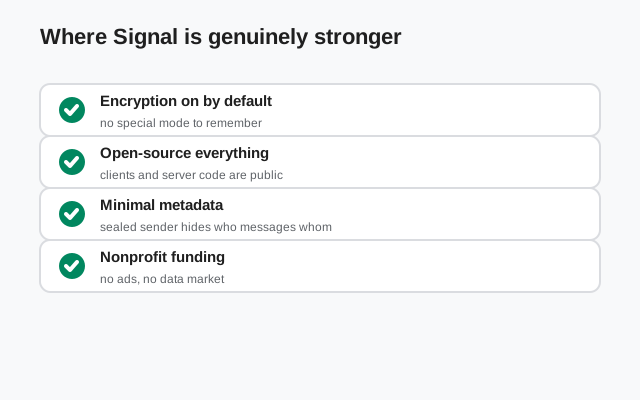
Default end-to-end encryption on everything. Chats, groups, calls, all of it, with no action required. The privacy does not depend on you knowing about Secret Chats or remembering to start one.
A protocol the world has checked. The Signal Protocol is open, and it has been studied, audited, and adopted by others (including WhatsApp). MTProto is Telegram's own design, and while it has been reviewed, it has not received anything like the same depth of independent scrutiny. In cryptography, novelty is a risk, not a feature.
Open servers, nonprofit owner. Signal's server code is public and its owner is a nonprofit with no advertising business. Telegram's servers are closed and its owner is a private company that now runs ads and sells Premium subscriptions. Again: judge by incentives and verifiability, not by personalities.
Minimal data by design. Because Signal stores no message history on its servers, there is almost nothing to seize, leak, or sell. Telegram's cloud, for all its convenience, is a large database of readable conversations sitting in one company's infrastructure. That is a meaningful difference in what a breach or a court order can reach.
Phone numbers and usernames
Both apps require a phone number to register, so neither is anonymous at signup. The difference is what happens after. Telegram has long let you set a username and interact in groups and channels without revealing your number, and it is genuinely good at this. Signal historically tied your identity to your number everywhere, but it has since added usernames: you can now share a username instead of your number, and control who can see your number in detail.
Practical upshot: on Telegram, number-hiding is mature and woven into the public ecosystem. On Signal, it is newer but works for private conversations. Neither app lets you register without a number today (Signal is testing number-free accounts, but that is still in beta). If your threat model is "no phone number attached to my identity at all," neither app fully satisfies you yet.
Who should pick which
| Your situation | The honest pick |
|---|---|
| Private one-to-one and group conversations | Signal. Real end-to-end encryption by default, no configuration needed. |
| Following channels, creators, or news | Telegram. Signal has no broadcast features at all. |
| Running a large community or group | Telegram. Bigger groups, bots, moderation tools. Accept that group content is server-readable. |
| Journalism, activism, or sensitive work | Signal. Defaults, protocol scrutiny, and minimal stored data. |
| You want history on every device instantly | Telegram. Its cloud sync is unmatched. Signal keeps history on devices. |
| You distrust big-company data collection | Signal. Nonprofit, open servers, nothing to sell. |
| Public identity without exposing your number | Telegram (mature usernames and public ecosystem). |
Many people sensibly use both: Telegram as a social and broadcast platform, Signal as the place for conversations that need to stay private. That split mirrors what each app was actually designed to be.
If Signal is your pick and your phone has no Play Store, get the official build from the source: our Signal APK download guide shows how to verify it. For how Signal's two official builds differ, see Signal APK vs Play Store.
Frequently asked questions
Are Telegram chats end-to-end encrypted?
Ordinary Telegram chats are not. They are encrypted between your device and Telegram's servers, but Telegram stores them in readable form. Only manually started one-to-one "Secret Chats" are end-to-end encrypted, and there is no secret group chat option.
Is Signal more private than Telegram?
Yes, for messaging privacy. Signal encrypts everything end to end by default, uses a widely audited protocol, stores no message history on its servers, and is run by a nonprofit. Telegram's default chats are server-readable and its servers are closed.
What is a Telegram Secret Chat?
An opt-in, one-to-one chat with end-to-end encryption, self-destruct timers, and no forwarding. It must be started manually per contact, is tied to one device, and is not available for groups.
Why do people say Telegram is not secure?
Because its default chats are stored on Telegram's servers in readable form, and many users wrongly assume they are end-to-end encrypted. Telegram's cloud convenience and its custom MTProto protocol (instead of the widely studied Signal Protocol) also draw criticism from cryptographers.
Can I use both Signal and Telegram?
Yes. A common setup is Telegram for channels, groups, and public communities, and Signal for private conversations. They serve different purposes well.
Does Telegram need my phone number?
Yes, to register. After that you can use a username and hide your number from other users, which Telegram handles better than most messengers.
Related guides
- All Signal comparisons: the full compare hub
- Signal vs WhatsApp: the metadata debate
- Is the Signal APK safe?: honest safety assessment
- Download the official Signal APK: verified download walkthrough
- Telegram APK vs Signal APK: official channels and real differences