
The Best Private Messengers in 2026: an Honest Ranking
Published: October 7, 2026
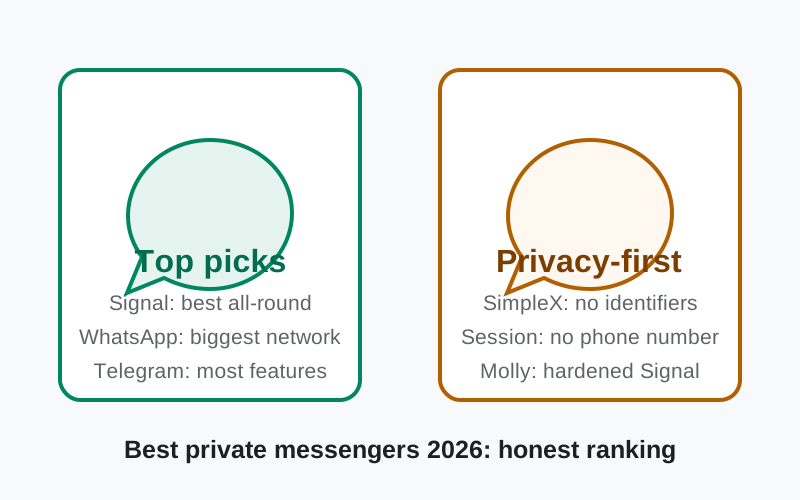
The headline up front: Signal is the best all-round private messenger for most people. This ranking is an honest, editorial assessment of the six messengers worth considering in 2026: Signal, WhatsApp, Telegram, SimpleX Chat, Session, and Molly. Each is judged on five criteria: default end-to-end encryption, metadata minimization, open source, usability, and network size.
But "most people" is not everyone. WhatsApp wins on network, Telegram wins on features, SimpleX wins on metadata. The verdicts below say exactly who should pick what.
from Signal's official site — file hosted by Signal, not by us
How we rank: the criteria
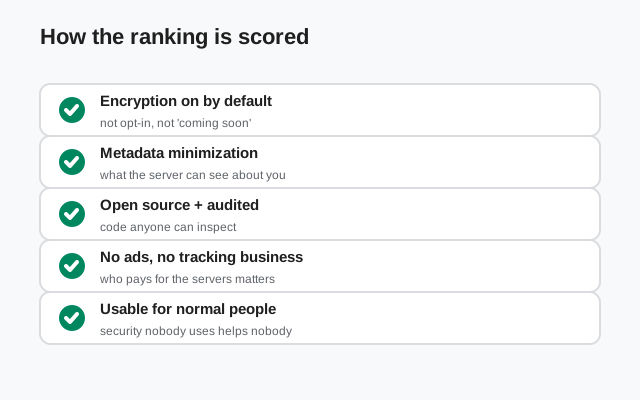
A private messenger has to do five things well. We weighed all five, and we say so openly because different people weight them differently:
- Default end-to-end encryption. Is everything encrypted without the user doing anything? Opt-in "secret chats" lose points. Most users never turn them on.
- Metadata minimization. Beyond message content, what can the operator learn: who talks to whom, when, from where? Less is better.
- Open source. Can independent experts inspect the code? Closed code asks for blind trust.
- Usability. Is it pleasant to use, with calls, desktop apps, and reliability? A private app nobody enjoys using does not get used.
- Network size. Are your people already there? The most private messenger in the world is useless if you are alone on it.
What we did not do: run benchmarks, measure speeds, or assign numerical scores. Any site showing you "Privacy Score: 9.4/10" for messengers is dressing up opinion as science. This ranking is opinion: informed, explicit about its criteria, but opinion.
1. Signal: the best all-rounder
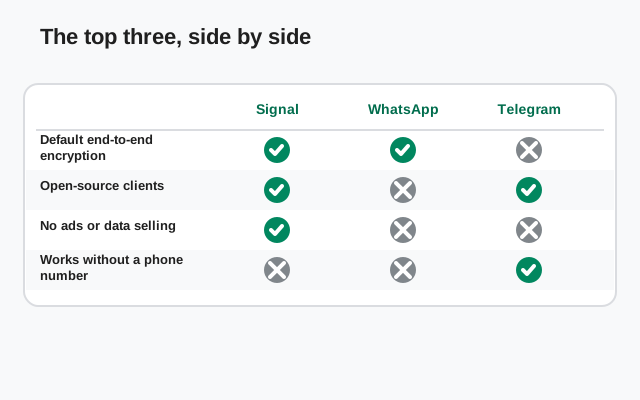
Signal tops this list because it is the only messenger that scores well on all five criteria at once. Encryption is end to end by default for everything, including group calls. Metadata collection is minimal: no message content stored, no readable contact lists, and sealed sender hides who messages whom from the server. The clients are open source. It is genuinely pleasant to use, with reliable calls, desktop apps, and disappearing messages. And its network is large. Not WhatsApp-large, but big enough that many of your contacts are one install away.
Its honest weaknesses: it requires a phone number to register (usernames now soften this, but the number is still needed), it is run on centralized servers by one nonprofit, and it lacks the giant feature catalog of Telegram. None of these disqualify it. For the average person who wants private messaging without thinking about it, Signal remains the recommendation: ours, and that of most security professionals.
2. WhatsApp: the pragmatic choice
Here is the honest take most privacy rankings will not give you: for billions of people, WhatsApp is the rational choice. It uses the Signal Protocol, so message content is end-to-end encrypted by default. And its network is unmatched: in much of the world, "everyone" is on WhatsApp, which means private encrypted messaging with zero convincing required.
The trade-offs are real and should be stated plainly. WhatsApp is owned by Meta, and while message content is encrypted, the metadata picture is far weaker than Signal's: account information, address-book uploads, and usage patterns feed a company whose business is advertising. The app is closed source, so its encryption claims cannot be independently verified the way Signal's can. Backups to cloud storage have historically been a weak point worth checking.
Verdict: if your contacts will not leave WhatsApp, you still get genuinely encrypted messages. That is a meaningful win. If you can move your inner circle, Signal's metadata story is much stronger.
3. Telegram: the feature king, with a privacy asterisk
Telegram deserves its place for features and speed: huge groups, channels, bots, multi-device sync that actually works, and a polished experience. Its network is enormous. For public broadcasting and community features, nothing else comes close.
The asterisk is large and honest: Telegram chats are not end-to-end encrypted by default. Only opt-in "secret chats" are, and they are device-specific and missing most features. Regular chats are stored on Telegram's servers, readable by Telegram. For a "private messenger" ranking, that is a fundamental gap. It is why Telegram sits third despite winning on features and network.
Verdict: superb for public channels and big communities; not a private messenger for one-to-one conversation unless both parties use secret chats, which almost nobody does.
4. SimpleX Chat: the metadata champion
SimpleX earns its spot on the strength of one radical design decision: no user identifiers at all. No phone numbers, no usernames, no account IDs. Messages move through relay servers holding anonymous queues, so there is no account database to leak and no social graph to build. On the metadata criterion, it beats everything else on this list by design.
Everything else is a trade-off. The network is small. Your contacts are almost certainly not there. The software is younger and less polished than Signal's, with manual contact setup via invitation links. Its encryption is its own design rather than the decade-audited Signal Protocol. For most people, these costs outweigh the metadata gain.
Verdict: the strongest choice for people whose safety depends on identifier-free communication: journalists, activists, anyone with a serious threat model. Overkill, but principled overkill, for everyone else.
5. Session: the no-number alternative
Session deserves mention as the established no-phone-number option. Like SimpleX it asks for no phone number; unlike SimpleX it uses onion-routed relay nodes for metadata protection and gives you an address (a Session ID) you can share. It is open source and its design takes metadata seriously.
Why fifth and not higher: the network is small, the app experience lags behind Signal's polish, voice and video calling have historically been a weak area, and development pace has been uneven. It is a legitimate choice for identifier-free messaging with a longer track record than SimpleX, but it asks you to accept a noticeably rougher product.
Verdict: worth knowing about if you refuse to hand any messenger your phone number but find SimpleX too bleeding-edge. A solid second-tier pick, not a first.
6. Molly: Signal, hardened
Molly is not a separate network. It is an independent, fully open-source fork of Signal's Android app that talks to Signal's servers and your Signal contacts. It exists for people who want Signal's network with extras: it strips out proprietary dependencies, adds features like encrypted local backups and database encryption, and is reproducible-build friendly.
Why last on the list despite being excellent software: it is Android-only, it is aimed at advanced users comfortable sideloading a fork, and, crucially, it inherits Signal's network and protocol. So it does not compete with Signal so much as extend it. Rank it as "Signal, for enthusiasts" rather than as an alternative.
Verdict: if you already chose Signal and want the hardest-core Android client for it, Molly is superb. As a standalone recommendation for most people, start with Signal itself.
What about iMessage, RCS, and the rest?
A fair question, since most readers already use one of these daily. Apple's iMessage encrypts blue-bubble chats end to end and is genuinely good. But it only exists inside Apple's ecosystem, and any chat with an Android user falls back to unencrypted SMS. That platform lock-in keeps it off a cross-platform ranking. Google Messages with RCS now encrypts one-to-one chats between Android users, which is real progress over SMS. But group RCS encryption is a newer story, the ecosystem is fragmented across carriers and apps, and the data collection around it is Google's. Neither is a choice you make; both are defaults you inherit with your phone.
The honest framing: iMessage and RCS are big upgrades over SMS and you should use them instead of texting. But when you actively choose a private messenger, when privacy is the point of the choice, the six apps ranked above are the ones competing for that job.
Side-by-side comparison
| Messenger | E2E by default | Identifier needed | Open source | Network | Best for |
|---|---|---|---|---|---|
| Signal | Yes, everything | Phone number | Yes | Large | Most people |
| Yes, messages | Phone number | No | Huge | Contacts who won't move | |
| Telegram | No (secret chats only) | Phone number | Clients only | Huge | Channels, communities |
| SimpleX | Yes, everything | None | Yes | Small | Maximum metadata privacy |
| Session | Yes | None (Session ID) | Yes | Small | No-number messaging |
| Molly | Yes (Signal network) | Phone number | Yes | Signal's | Signal power users |
Which app should you pick?
Everyday private messaging: Signal. No contest: encryption by default, minimal metadata, large network, pleasant app.
Your family will not install anything new: WhatsApp. Encrypted messages with the people you already have beat perfect privacy with nobody.
Running a public channel or huge community: Telegram. Accept that one-to-one chats are not end-to-end encrypted and keep sensitive talk elsewhere.
Serious threat model, no identifiers: SimpleX. The strongest metadata design available; accept the small network.
No phone number, established alternative: Session. Rougher than Signal, but identifier-free with a longer history than SimpleX.
Signal user who wants the hardened client: Molly. Same network, tougher app, Android only.
The honest bottom line: there is no single "best". There is a best for your situation. But if you forced us to name one app for one average person in 2026, it is Signal, and it is not particularly close.
Frequently asked questions
What is the most private messenger in 2026?
For most people, Signal: end-to-end encryption by default, minimal metadata, open source, and a large network. For the strictest metadata protection, SimpleX Chat's identifier-free design goes further, at the cost of a much smaller network.
Is WhatsApp private enough?
WhatsApp encrypts message content with the Signal Protocol, which is genuinely strong. Its weakness is metadata: as a Meta product it collects far more surrounding data than Signal, and the app is closed source. Good enough for everyday chats; not the choice for sensitive matters.
Is Telegram end-to-end encrypted?
Not by default. Only opt-in secret chats are end-to-end encrypted, and most users never enable them. Regular Telegram chats are stored on Telegram's servers.
What is Molly and is it safe?
Molly is an independent open-source fork of Signal's Android app. It connects to Signal's network and your Signal contacts, adding hardened features. It is well-regarded by privacy enthusiasts, but it is aimed at advanced Android users.
Do I really need to switch messengers for privacy?
It depends on your threat model. For most people, moving sensitive conversations to Signal while keeping WhatsApp for everyone else is a sensible, low-friction improvement. You do not need the perfect setup - you need better than SMS.
Related guides
- Signal vs WhatsApp in depth: the full head-to-head behind this ranking
- Signal vs SimpleX in depth: the metadata-design comparison
- Signal vs Session in depth: the no-number alternative examined
- is Molly safe: the hardened Signal fork explained
- download the official Signal APK: the verified build from Signal's own site