
Signal vs SimpleX Chat: Honest Comparison
Published: October 7, 2026
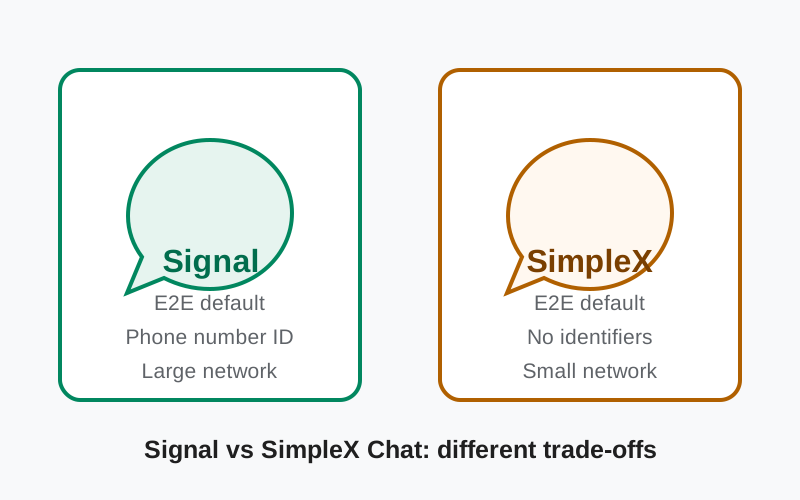
Both Signal and SimpleX Chat are serious private messengers with end-to-end encryption, and this comparison is honest: neither one "wins" for everyone. Signal is the easy, mature choice for most people. It uses your phone number, has a large user base, and its voice and video calls work reliably. SimpleX is the radical-privacy choice. It has no user identifiers at all: no phone numbers, no usernames, no account IDs. So there is nothing to tie your conversations to you. That privacy comes with trade-offs: a smaller network and younger, rougher software.
Below we compare how each one identifies you, how their networks work, what is encrypted, and how they feel to use, then give a straight pick-by-situation verdict.
from Signal's official site — file hosted by Signal, not by us
The short answer
If you want private messaging that works today with the people you already know, pick Signal. Your contacts can find you, calls work well, and apps exist for Android, iOS, and desktop. If your situation is stricter (you do not want any account, phone number, or identifier anywhere in the system), pick SimpleX. It is the only well-known messenger that gives you truly identifier-free messaging, but expect a smaller contact list and a less polished app.
Side-by-side comparison
| Feature | Signal | SimpleX Chat |
|---|---|---|
| Identifier required | Phone number (usernames optional) | None. No numbers, IDs, or usernames. |
| End-to-end encryption | Yes, default for everything | Yes, default for everything |
| Network model | Centralized servers (Signal Foundation) | Relay/queue servers, no accounts |
| Metadata minimization | Strong (sealed sender, minimal logs) | Stronger by design (no identifiers exist) |
| Voice/video calls | Yes, reliable, incl. group calls | Supported, narrower feature set |
| Desktop apps | Yes, mature | Available, less mature |
| Open source | Yes | Yes |
| Finding contacts | Automatic via phone number | Manual invitation links/QR codes |
| Network size | Large | Small |
| Maturity / audits | A decade of audits and real-world use | Newer, less battle-tested |
What Signal is
Signal is a nonprofit, open-source messenger run by the Signal Foundation. It is famous for the Signal Protocol, the same end-to-end encryption technology that WhatsApp also uses. Every chat and call in Signal is end-to-end encrypted by default. There is no toggle to enable and no "secret chat" mode to remember.
Signal asks for a phone number when you sign up. That number is your identity in the system, and it is how contacts find you. Signal has worked to reduce what the number reveals: you can set a username so new contacts do not need your number, and phone-number privacy settings let you hide it from people who are not contacts. Still, a phone number is required to create an account, and that is the main privacy trade-off of the design.
The app is mature. Voice and video calls are reliable, group calls work, desktop apps sync properly, and features like disappearing messages and view-once media are all polished. The official Android APK (current website build 8.29.3, package org.thoughtcrime.securesms) is published on Signal's own download page.
What SimpleX is
SimpleX Chat is a newer, open-source messenger built around one radical idea: there should be no user identifiers at all. No phone numbers, no email addresses, no usernames, not even random user IDs assigned by a server. To connect with someone you share a one-time invitation link or QR code. Once connected, you talk through anonymous addresses that reveal nothing about either party.
Because there are no identifiers, there is no account database to hack, no phone-number list to leak, and no directory an attacker can scrape. That makes SimpleX arguably the strongest design of any well-known messenger against metadata collection. There is simply less metadata to collect in the first place.
The cost is convenience and maturity. SimpleX is younger software with a far smaller user base. Finding contacts is manual (you cannot search for someone by name or number), and the feature set is narrower than Signal's. It is open source, which is good, but it has not had the decade of audits and real-world testing that Signal has.
The big difference: how you are identified
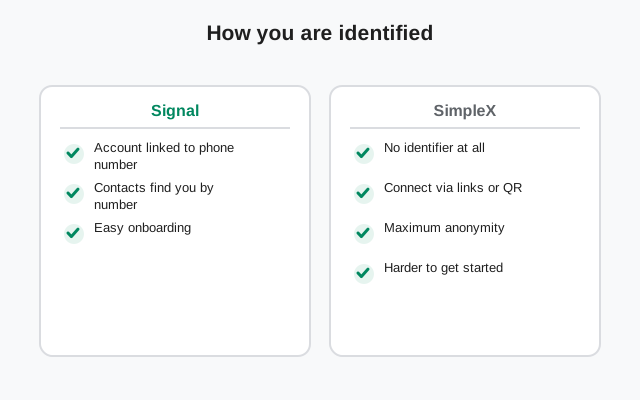
This is the heart of the comparison. In Signal, you are your phone number, plus an optional username. Anyone who knows your number can message you, and Signal's servers run an encrypted contact-discovery system around those numbers. Signal minimizes what this leaks: sealed sender means the server does not even see who is messaging whom in most cases. But the identifier exists.
In SimpleX, there is nothing. Two people who chat have no shared identifier between them that a third party could read. Even the servers that relay your messages cannot build a social graph, because there are no accounts to link together. For most people this is overkill. For people who genuinely need anonymous communication (journalists protecting sources is the classic example), it is exactly the point.
The practical side matters too. Signal's phone-number model means your existing contacts are one install away: you open Signal and your address book shows everyone already on it. SimpleX's model means every single contact is a manual step: you generate an invitation, send it through some other channel, and they accept it. Starting from zero contacts is a real cost, and it is the main reason most people will not switch.
Network design: central servers vs relay queues
Signal runs on centralized servers operated by the Signal Foundation. All users connect to the same infrastructure. Centralization has downsides: one organization to trust, one target to attack. But it is also why Signal is fast, reliable, and consistent across devices. The server code is open, and the service is funded by donations, not ads or data.
SimpleX takes a different path. Instead of central servers holding accounts, messages pass through a network of relay servers that hold temporary message queues. The servers never see accounts, only anonymous queues, and anyone can run a relay server. In principle this means no single operator controls the network. In practice the experience is less uniform than Signal's single well-run service, and the network is only as strong as its relay operators.
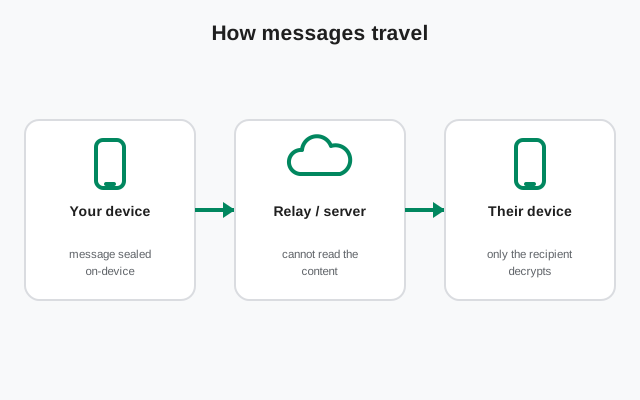
Neither design lets a server read your message content. Both are end-to-end encrypted. The difference is what the server can learn around the edges. Signal's servers handle phone-number-based accounts, with strong protections around that. SimpleX's relay servers handle identifier-free queues with essentially no user metadata attached.
Encryption and metadata
Both apps encrypt message content end to end by default, with forward secrecy: if a key is ever compromised, old messages stay unreadable. Signal's protocol is the industry reference. It has been audited repeatedly and copied by WhatsApp, Google Messages, and others. SimpleX uses its own encryption design, also with forward secrecy, built for its identifier-free model.
Where they differ is metadata. Signal collects very little: no message content, no readable contact lists. But it does operate accounts tied to phone numbers. SimpleX collects even less by construction, because there are no accounts and no identifiers to collect. If your concern is "can anyone prove I talk to this person," SimpleX's design gives the stronger answer. If your concern is "can anyone read my messages," both are excellent.
One honest note: Signal's long track record is itself a security feature. A protocol that has survived a decade of attacks and audits carries weight that a newer design, however clever, has not yet earned. New cryptography needs time to prove itself, and that time has not fully passed for SimpleX.
Usability and maturity
Signal feels like a finished product because it is one. Onboarding takes a minute: install, verify your number, done. Calls are high quality, group calls work, desktop apps sync, and features like disappearing messages, view-once media, and usernames are all polished. When something breaks, there is a large community and years of documentation to help.
SimpleX feels like a promising project that is still growing up. The apps work, but expect rougher edges: manual contact setup, a smaller ecosystem, fewer conveniences. Development is active and the trajectory is good, but if you measure "does it just work for my family group chat," Signal wins comfortably today.
Network size is the other half of usability. A messenger is only useful if your people are on it. Signal has a large global user base. Not WhatsApp-large, but big enough that many of your contacts are probably already there or will install it when asked. SimpleX's user base is small by comparison. The best encryption in the world does not help if you are talking to yourself.
Who should pick which: an honest verdict
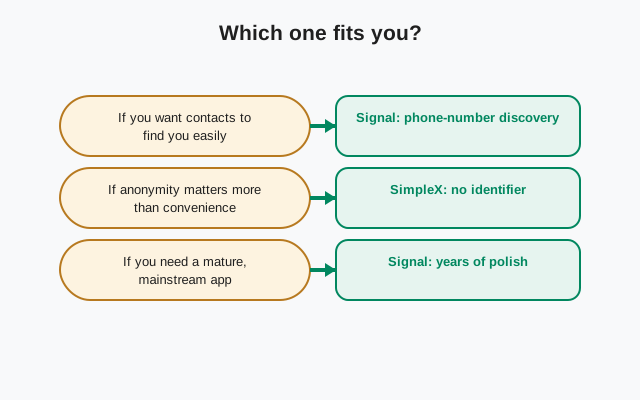
Pick Signal if: you want private messaging for everyday life: family, friends, work groups. You get strong encryption, a phone number people can reach you on, reliable calls, and a big enough network that you will not be alone. This is the right answer for the vast majority of readers.
Pick SimpleX if: you specifically need identifier-free communication: no phone number attached to your messaging at all. If you are a journalist, activist, or anyone whose safety depends on nobody being able to connect your chats to your identity, SimpleX's design is genuinely the strongest option available. Accept the smaller network and rougher edges as the price.
Use both if: you are privacy-curious: Signal for daily life, SimpleX for the conversations that need maximum metadata protection. There is no rule that says you must pick one messenger for everything.
The honest bottom line: Signal is the better product for most people today; SimpleX is the better design for the hardest privacy cases. Neither is a bad choice. Both are miles ahead of SMS or an unencrypted chat app.
Frequently asked questions
Is SimpleX really more private than Signal?
By design, yes in one specific way: SimpleX has no user identifiers at all, so there is no account or phone number that could link your conversations to you. Signal encrypts everything and minimizes metadata, but it does require a phone number. For message content, both are excellent.
Does SimpleX have voice and video calls?
SimpleX supports calls, but its calling features are narrower and less polished than Signal's. If high-quality voice and video calls matter to you, Signal is the stronger choice today.
Can I use SimpleX without a phone number?
Yes - that is the whole point. SimpleX asks for no phone number, email, or any other identifier. You connect with people through one-time invitation links or QR codes.
Is Signal still private if it needs my phone number?
Signal keeps your number's exposure low: chats and calls are end-to-end encrypted, sealed sender hides who messages whom from the server, and usernames let new contacts reach you without seeing your number. The number is still required to register, which is the trade-off.
Which one should a beginner choose?
Signal. It installs in a minute, your contacts appear automatically, and everything just works. SimpleX is worth exploring once you are comfortable, especially if identifier-free messaging appeals to you.
Related guides
- our Session comparison: another metadata-focused messenger, compared with Signal
- how Signal compares with WhatsApp: the mainstream alternative most people switch from
- Signal phone-number privacy settings: how to hide your number from non-contacts
- download the official Signal APK: the verified build from Signal's own site
- Signal vs the Molly fork: the independent FOSS Signal fork explained