What is Molly? The Signal fork, explained
Published: October 7, 2026 · Updated: October 8, 2026
Molly is an independent, open-source fork of the Signal Android app, built by third-party developers at molly.im. It is not official Signal, and it is not made by, endorsed by, or affiliated with Signal Foundation. Molly connects to the same Signal network and speaks the same protocol, so Molly users can chat with Signal users normally. Your contacts cannot tell which app you use. Molly exists mainly for people whose phones lack Google services (Huawei devices, GrapheneOS, other de-Googled setups): its FOSS build replaces Google-based push notifications with UnifiedPush or a direct background connection, and it adds a few features the official app does not ship, like passphrase-locked local database encryption. This page explains what a fork is, who makes Molly, and where it fits.
What "fork" actually means
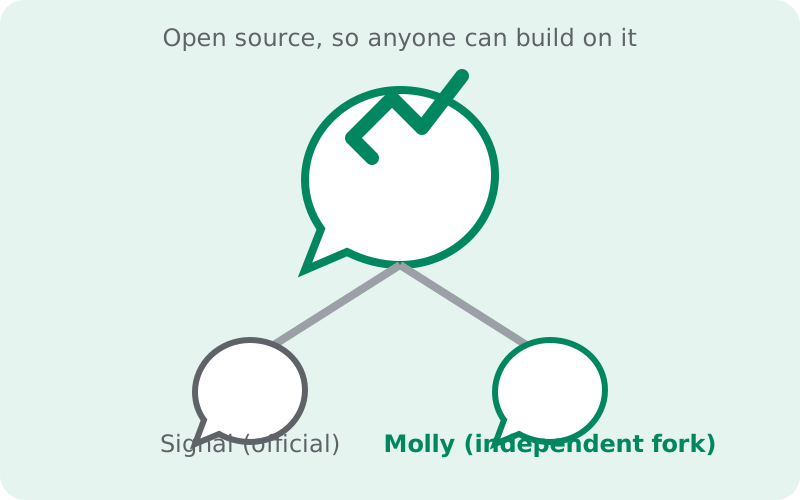
The word "fork" gets thrown around loosely, so let's pin it down. Signal's Android client is open-source software, published under the AGPLv3 license. That license explicitly allows anyone to take the code, modify it, and publish their own version. A fork is what happens when a group does exactly that, in the open, as an ongoing project: they copy the codebase, make their changes, publish their own releases, and maintain it over time. It is a separate project with its own developers, its own release notes, its own signing keys, and its own update channel.
This is very different from a "mod." Mods of messaging apps are usually one person's repackaged APK with unknown changes, no published source code, and no maintenance story. A real fork has a public repository you can read, a documented build process, and releases you can verify. If someone offers you a "Signal mod" and there is no source code to inspect, it is not a fork. Treat it as hostile. Molly clears this bar: it is a genuine fork with published code and reproducible builds, meaning you can verify that the APK it distributes was built from the source code it publishes.
The fork model also explains something people find confusing: Molly is allowed to exist. Signal's license permits forks, and forks of open-source apps are normal in the software world. What Molly may not do is pretend to be Signal, and it doesn't. It is clearly labeled as an independent project. The Molly hub on this site keeps a full map of the fork's guides if you want the deep dives.
Why Molly exists
Molly exists because of a tension inside the official Signal app: parts of it depend on Google services. The most visible one is push notifications. On a normal phone, when a message arrives, Google's Firebase Cloud Messaging (FCM) wakes the Signal app and shows you the notification. On phones without Google services (Huawei phones after the trade restrictions, GrapheneOS, CalyxOS, other de-Googled setups), FCM simply isn't there. Official Signal can still work on such phones through a built-in background connection, but the experience is rougher, and some Google-adjacent pieces (parts of contact discovery, for example) don't behave the same.
For people who chose a Google-free phone deliberately, this is a real problem: they picked the phone for independence from big tech, and their messenger quietly depends on Google's push servers. Molly was built to remove that dependency. It replaces Google push with UnifiedPush, an open push standard, or with a direct background connection that talks to no Google server at all. The result is a Signal-compatible messenger that works fully on Google-free phones, with notifications that arrive without Google in the loop.
There is a second, smaller motivation: features. Molly adds a few things the official app doesn't ship, the most notable being encrypted database storage at rest: you can lock Molly's local message database with a passphrase, so someone who gets hold of your phone doesn't automatically get your message history. Official Signal encrypts messages in transit and at the protocol level, but its local database isn't passphrase-locked the way Molly's can be. For most users this is a nice-to-have. For people with a serious threat model (journalists, activists, anyone whose phone might be seized), it is a meaningful difference.
Who makes Molly
Molly is made by independent developers: a small third-party team, not a company and not Signal Foundation. We won't name names here, because the roster of an open-source project changes over time and we don't invent facts; what matters structurally is the shape of the project. It is developed in the open, its code is public, its builds are reproducible, and it publishes its own signing keys and release notes. Those are the right foundations for trust in a fork.
But "right foundations" is not the same as "same resources." Signal Foundation is a funded nonprofit with a full-time security team, infrastructure engineers, and a legal department. Molly is a community project. That difference shows up in two places that matter: release speed (Molly follows Signal's releases, so security fixes can land a little later) and support (if something breaks, the community and molly.im documentation are your help desk, not Signal's support team). Neither is a dealbreaker, but both are worth knowing before you switch. Our Molly vs Signal comparison weighs the fork's trust model in more detail.
Same network, same protocol
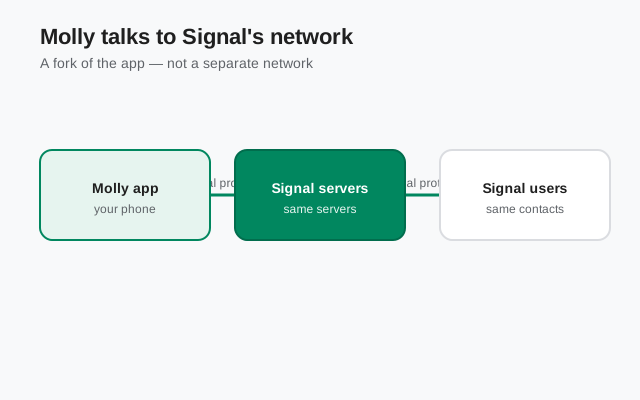
Here's the part that surprises people: Molly and Signal are fully interoperable. Molly speaks the Signal protocol and connects to the same Signal servers, so a Molly user and a Signal user can chat, call, join the same groups, and use disappearing messages together with no friction. Your contacts cannot tell which app you are using. End-to-end encryption works the same way, because it is the protocol doing the work, not the app wrapper around it.
This is also why switching is practical. Your identity on the network is your phone number plus your cryptographic keys, not the app you installed. Moving between Signal and Molly uses the same encrypted backup files both apps understand: back up in one, restore in the other. It is not magic and it is not instant. You should plan it, confirm your backup passphrase, and know that linked devices complicate things. But the path exists and is documented. The practical upshot: choosing Molly is not choosing a different network or a smaller contact list. It is choosing a different client for the same network.
Two variants, one project
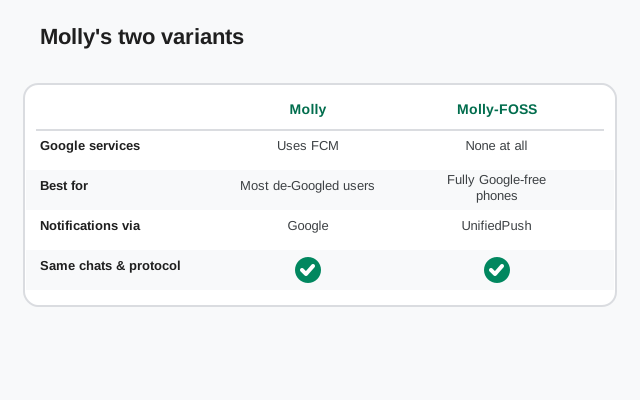
Molly ships in two builds, and picking one is the first decision every new user faces. Standard Molly keeps Google's FCM for notifications (like the official app) while adding the fork's extra features and removing some other Google dependencies. Molly-FOSS removes all remaining proprietary components (no closed-source Google code at all) and uses UnifiedPush for notifications instead.
The rule of thumb is simple: if your phone has Google services and works fine, standard Molly gives you the extras with the familiar, reliable FCM notifications. If your phone has no Google services, or you want zero proprietary code on principle, Molly-FOSS is the build made for you. Both come from the same project, both follow Signal's releases, and both install as separate apps from molly.im. The Molly vs Molly-FOSS guide compares the two builds head to head so you can pick with confidence.
What Molly is (and is not): one table
| Claim you'll hear | The reality |
|---|---|
| "Molly is official Signal" | False. It is an independent fork by third-party developers at molly.im. Not made, endorsed, or supported by Signal Foundation. |
| "Molly is a modded/hacked Signal" | False. It is a genuine fork: public source code, reproducible builds, its own releases and signing keys. |
| "Molly users can't message Signal users" | False. Same protocol, same network. Chats, groups, and calls work across both apps. |
| "Molly is more private than Signal by default" | Mostly false. The protocol and encryption are identical. Molly's privacy edge is situational: no Google in the notification path (FOSS build) and optional passphrase-locked local database. |
| "Molly is only for de-Googled phones" | False, but close to the point. Anyone can use it, but its case is strongest on Google-free phones. On a normal phone, the official app is usually simpler. |
| "Molly is on the Play Store / F-Droid main repo" | False. It is distributed from molly.im and through its own F-Droid repository, which you add to the F-Droid client yourself. |
If you take one thing from this table, make it the first row. Every bad decision people make about Molly (downloading it from a random mirror, expecting Signal's support team to help, assuming it updates the moment Signal does) starts from forgetting that it is an independent project.
How Molly tracks Signal releases
Because Molly is a fork, its releases follow Signal's. When Signal ships a new Android version with features or security fixes, Molly's developers merge the changes, build, test, and publish their own release. That pipeline takes time, so Molly's releases land a little after Signal's: a short delay, not a season, but a real one. For feature updates this barely matters. For security fixes it matters a bit more: there is a window, however small, where official Signal users have a patch and Molly users don't yet.
How much should you care? For most people, not much. The delay is short and the project is maintained. But if you are the kind of person who installs security updates the hour they land, you should know the fork adds a step to that pipeline. This is one of the honest costs of using any fork, and it applies to Molly the same as any other. Watch molly.im's release notes rather than Signal's if you want to know when your build is current.
Who should care, and who shouldn't
You should look at Molly if: your phone has no Google services (Huawei, GrapheneOS, de-Googled ROMs) and you want Signal-class messaging with working notifications; you want zero proprietary Google code on your device; or you want the passphrase-locked local database for extra at-rest protection. For these users Molly isn't a curiosity. It's the practical answer.
You can skip Molly if: your phone has Google services and everything works. The official app gives you the same protocol, the same encryption, faster security updates, and official support, with none of the fork's tradeoffs. There is nothing wrong with preferring the simpler, better-supported option. Most people should. If that is you, the official Signal APK download guide is the page you want, not this silo.
And if you're somewhere in between (curious about the fork but not sure the tradeoffs are worth it), read the honest Molly vs Signal differences next. It lists exactly what changes and what doesn't, so the decision is based on facts instead of forum hype.
from Signal's official site (file hosted by Signal, not by us)
One last note on honesty: this site is an independent guide. We are not affiliated with Signal Foundation, and we are not affiliated with Molly's developers either. We link to molly.im because it is the fork's official source, and to signal.org because it is Signal's. We don't host anyone's APK.
Frequently asked questions
Is Molly official Signal?
No. Molly is an independent fork built by third-party developers at molly.im. It is not made, endorsed, or supported by Signal Foundation. It connects to the same Signal network, but it is a separate app with its own releases.
Who makes Molly?
Independent developers, as an open-source community project. The code is public and the builds are reproducible. It is not a company product and has no connection to Signal Foundation beyond building on Signal's open-source client.
Can Molly users message Signal users?
Yes. Molly speaks the same Signal protocol on the same network, so chats, groups, calls, and disappearing messages work across both apps. Your contacts cannot tell which app you use.
Is Molly free?
Yes. Like Signal, Molly is free and open-source software. There is no paid version, no premium tier, and no 'Molly Pro'. Anything calling itself that is a scam riding on the fork's name.
Why would I use Molly instead of just using Signal?
The strongest reasons are a Google-free phone (Huawei, GrapheneOS, de-Googled setups) where Molly's UnifiedPush notifications replace Google's FCM, and the optional passphrase-locked local database. On a normal phone with Google services, official Signal is usually the simpler choice.
Keep reading
- Molly hub: the full map of fork guides
- Molly vs Signal: the honest differences, side by side
- Install Molly APK: the safe install path from molly.im
- Molly vs Molly-FOSS: which build to pick
- Signal vs Molly comparison: the head-to-head view
- Official Signal APK: if you'd rather skip the fork